Paint Protection Film
Brezza PPF Price 2026: Full & Partial Coverage Costs in India
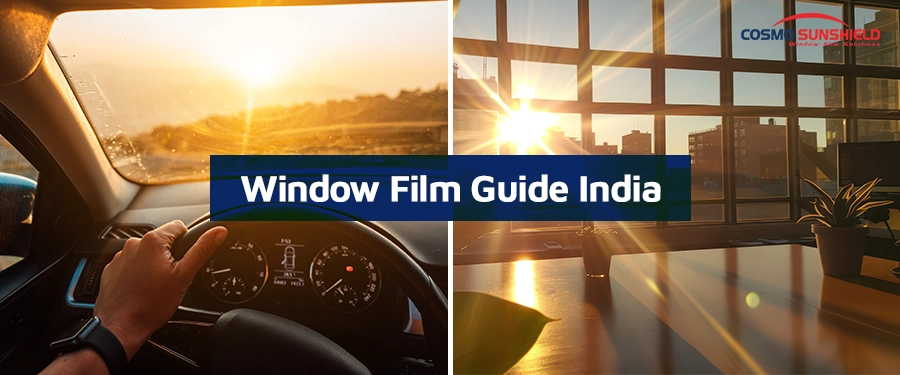
Every car and every building in India shares the same weak point: its glass. Glass gives a car its sense of space and a home its view, but it also lets the sun straight in. Park a car in the open on a May afternoon and within the hour the steering wheel is too hot to hold, the dashboard is baking and the air conditioner needs ten minutes just to make the cabin bearable. Step into a glass-fronted office at three in the afternoon and the blinds are down, the lights are on and the cooling bill keeps climbing.
Most of that heat is invisible. Roughly half of the sun's energy arrives as infrared radiation, which is what turns a cabin or a room into an oven. Another few percent arrives as ultraviolet, which fades dashboards, leather, wooden floors and fabrics, and reaches skin through glass more easily than most people realise. A study published in JAMA Ophthalmology measured 29 cars and found that while windscreens blocked about 96% of UVA on average, side windows blocked only 71%, and some as little as 44%. In India the driver sits on the right, so it is the right arm and the right side of the face that absorb that exposure on every drive.
Window film fixes this at the glass itself, without replacing a single pane. It is a precision-engineered, multi-layer polyester film applied to existing glass that rejects infrared heat, blocks more than 99% of UV, cuts glare, adds privacy and holds shattered glass together. Modern films can deliver significant heat, UV, glare, privacy and safety benefits while maintaining the level of clarity or appearance the application requires, from near-clear nano-ceramic films to reflective, tinted and frosted finishes.
This guide from Cosmo Sunshield covers everything you need to know: how window film works, the technologies behind it, the legal position for cars in India, the full Cosmo Sunshield automotive and architectural range, how to choose the right film, and how it should be installed and cared for.
Understanding Window Film
Window film is a thin, multi-layer polyester (PET) film applied to the inside surface of glass in cars and buildings. It turns ordinary glass into a performance surface that controls how much heat, UV and visible light pass through, and it can add privacy, safety and style.
Every quality film is built in layers, and each layer has a job:
How does window film work?

Sunlight reaches glass as three kinds of energy: ultraviolet, visible light and infrared. When it strikes a window film, part of that energy is reflected, part is absorbed and part passes through. The functional layer decides the balance.
This is the principle of spectral selectivity: stop the energy you don't want, and let through the light you do.
Benefits of window film
Key performance terms: VLT, IRR, TSER and UV
Every film is described by a few numbers. Knowing them makes it easy to compare films accurately.
|
Term |
What
it measures |
What
it means for you |
|
VLT (Visible Light Transmission) |
The percentage of visible light that passes through |
Higher VLT means clearer, brighter glass. India's car
glass rules are written in VLT. |
|
IRR (Infrared Rejection) |
The percentage of infrared heat rejected |
An important indicator of how effectively a film can
reduce the infrared heat entering a cabin or room. Higher IR rejection helps
improve thermal comfort. |
|
TSER (Total Solar Energy Rejected) |
The percentage of all solar energy (UV, visible and
infrared) kept out |
A whole-spectrum figure. Always lower than IRR on a
clear film, because clear film deliberately lets light in. |
|
UV rejection |
The percentage of ultraviolet blocked |
Protection for skin and interiors. Cosmo Sunshield
films block more than 99%. |
|
SHGC (Solar Heat Gain Coefficient) |
The share of solar heat that ends up inside a building |
Used for architectural glass. Lower SHGC means less
heat gain. |
|
Film type |
Heat rejection |
Signal friendly |
Colour stability |
Clarity |
|
Dyed |
Low |
Yes |
Fades over time |
Moderate |
|
Metallised |
High |
No |
Good |
Reflective |
|
Carbon |
Moderate |
Yes |
High |
Good, matte tint |
|
Nano-ceramic |
Very high |
Yes |
Very high |
Excellent |

|
Window |
Minimum VLT |
|
Front windscreen |
70% |
|
Rear windscreen |
70% |
|
Side windows |
50% |
|
Choice |
Status |
Why |
|
Black or dark tint |
Not permitted |
Below the VLT limits and prohibited under the 2012
Supreme Court order |
|
Mirror or reflective film on road glass |
Not permitted |
Fails the VLT limits and creates glare for other road
users |
|
Window safety glazing within 70% / 50% VLT |
Recognised under the amended framework |
Recognised by the 2021 amendment and addressed in the
2024 Kerala ruling; enforcement varies by state |
|
Factory-tinted glass within VLT limits |
Compliant |
Meets Rule 100 as manufactured |
|
CoolMax Prime |
VLT |
TSER |
IR heat rejected (up to) |
UV rejected |
|
Prime 80 |
80% |
35% |
75% |
>99% |
|
Prime 70 |
70% |
50% |
90% |
>99% |
|
CoolMax Guard |
VLT |
TSER |
IR heat rejected (up to) |
UV rejected |
|
Guard 80 |
80% |
35% |
75% |
>99% |
|
Guard 70 |
70% |
50% |
90% |
>99% |
|
Guard 50 |
50% |
55% |
95% |
>99% |
|
Carbomax Prime |
VLT |
TSER |
Glare reduction (up to) |
UV rejected |
|
Prime 70 |
70% |
25% |
25% |
>99% |
|
Carbomax Guard |
VLT |
TSER |
Glare reduction (up to) |
UV rejected |
|
Guard 70 |
70% |
25% |
25% |
>99% |
|
Guard 50 |
50% |
30% |
45% |
>99% |
|
Defender |
VLT |
TSER |
UV rejected |
|
Defender 70 |
70% |
20% |
>99% |
|
Maxtone |
VLT |
TSER |
UV rejected |
|
Maxtone 70 |
70% |
20% |
>99% |
|
Maxtone 50 |
50% |
25% |
>99% |
|
Your priority |
Front windscreen |
Side windows |
Rear windscreen |
|
Maximum heat rejection and comfort |
CoolMax Prime 70 or 80 |
CoolMax Guard 50 or 70 |
CoolMax Guard 70 or 80 |
|
Fade-resistant style and glare control |
Carbomax Prime 70 |
Carbomax Guard 50 or 70 |
Carbomax Guard 70 |
|
Everyday UV and glare protection |
Defender 70 |
Maxtone 50 or 70 |
Maxtone 70 |
|
Film |
Technology |
Position |
VLT options |
TSER (up to) |
IR rejection (up to) |
Glare reduction (up to) |
UV rejected |
|
CoolMax Prime |
Nano-ceramic |
Front |
70%, 80% |
50% |
90% |
– |
>99% |
|
CoolMax Guard |
Nano-ceramic |
Side + rear |
50%, 70%, 80% |
55% |
95% |
– |
>99% |
|
Carbomax Prime |
Carbon pigment |
Front |
70% |
25% |
30% |
25% |
>99% |
|
Carbomax Guard |
Carbon pigment |
Side + rear |
50%, 70% |
30% |
35% |
45% |
>99% |
|
Defender |
Long-life safety glazing |
Front |
70% |
20% |
– |
25% |
>99% |
|
Maxtone |
Long-life safety glazing |
Side + rear |
50%, 70% |
25% |
– |
40% |
>99% |
|
Ultra Cool variant |
Shade |
VLT |
IR heat rejected |
TSER |
SHGC |
|
CS-650-IT-8560 |
Transparent |
85% |
59% |
29% |
0.71 |
|
CS-650-CT-8065 |
Transparent |
83% |
65% |
32% |
0.68 |
|
CS-650-AC 7465 |
Transparent |
74% |
65% |
37% |
0.63 |
|
CS-650-AC 7090 |
Transparent |
70% |
93% |
49% |
0.52 |
|
CS-601-PACGP-5095 |
Graphite |
57% |
92% |
52% |
0.48 |
|
CS-650-PAC-5075 |
Transparent |
54% |
75% |
46% |
0.55 |
|
CS-600-PAC-3090 |
Transparent |
30% |
90% |
60% |
0.41 |
|
CS-601-PACGP-0595 |
Graphite |
5% |
95% |
70% |
0.31 |