
Paint Protection Film
Brezza PPF Price 2026: Full & Partial Coverage Costs in India

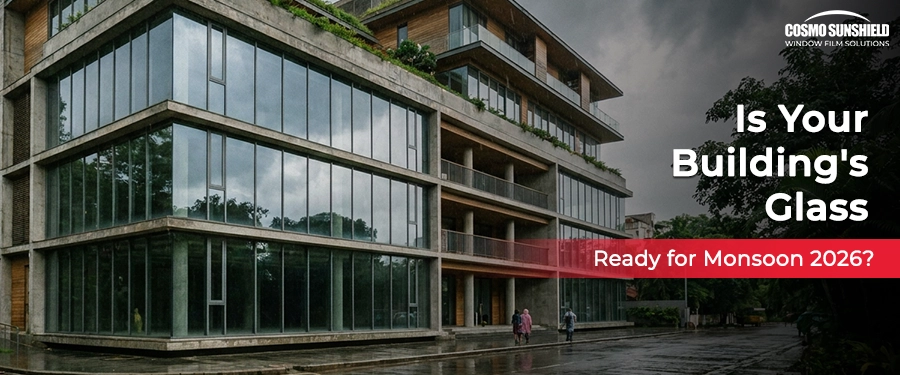
India loses thousands of crores every monsoon season to infrastructure damage, and a significant portion of that damage involves glass. Windows shatter during cloudbursts, sending shards into occupied rooms. Balcony doors fail under sustained wind pressure. Corridor glass in schools and hospitals becomes a debris hazard the moment a storm makes landfall.
What makes this particularly avoidable is that the damage rarely comes without warning. Cracked frames, hairline fractures, failed sealants, and brittle single-pane glass are all visible weeks before the rain arrives. The buildings that come through monsoon with minimal damage are almost always the ones where someone looked carefully before the first storm, not after it.
India's 2026 southwest monsoon is forecast to be erratic rather than uniformly heavy. Below-normal averages across North, West, and Central India will be punctuated by sudden, high-intensity cloudbursts and high-wind events, which are precisely the conditions most damaging to unprotected glazing. For buildings still carrying original single-pane glass, this is the season to act.
This guide covers what glass most Indian buildings actually have, the warning signs that indicate glass is already compromised, which building types carry the highest risk, and what safety and security window film does to address these vulnerabilities without replacing a single pane.
Table of Contents
1. Glass and Monsoon: The Quick Verdict
2. Why Monsoon 2026 Is a Higher Risk for Buildings Across India
3. What Type of Glass Is in Most Indian Buildings?
4. 7 Warning Signs Your Building's Glass Is Not Monsoon-Ready
5. Buildings Most Vulnerable to Monsoon Glass Damage in India
6. The Hidden Costs of Monsoon Glass Damage
7. How Safety and Security Window Film Protects Your Glass
8. Key Features to Look for in a Safety and Security Window Film
9. Safety Film vs. Glass Replacement: Which Makes More Sense?
10. Why Install Safety Film Before Monsoon Season Starts
11. Pre-Monsoon Glass Safety Checklist for Building Owners
12. Frequently Asked Questions About Safety Film and Monsoon
Glass and Monsoon: The Quick Verdict
Most buildings in India carry standard single-pane annealed float glass. It performs adequately under ordinary conditions, but during a monsoon storm with wind-driven debris or a sudden pressure surge, it fractures into sharp, fast-moving shards.
Safety and security window film does not replace the glass. It changes what happens when the glass breaks, so that fragments stay bonded to the film and remain held within the frame instead of dispersing into occupied spaces. The solution is a retrofit that requires no glass replacement, no frame modification, and no disruption to building operations.
|
Building Type |
Risk Level |
Primary Concern |
|
Homes and apartments |
Moderate to high |
Ground-floor windows, balcony sliding
doors |
|
Schools |
High |
Large low-mounted classroom windows,
corridors |
|
Hospitals |
High |
24-hour occupancy, clinical
contamination risk |
|
Commercial offices |
Moderate to high |
Floor-to-ceiling facades, atrium
glazing |
|
Government and civic buildings |
High |
Ageing single-pane glass, deferred
maintenance |

Why Monsoon 2026 Is a Higher Risk for Buildings Across India
India's 2026 southwest monsoon is forecast at 90% of the Long Period Average by the India Meteorological Department, with an 84% probability of below-normal rainfall nationally. July specifically is projected at 95% of LPA by Skymet, with equal chances of landing normal or below normal.
A weaker average does not mean a safer season. Below-normal monsoons concentrate rainfall into shorter and more intense bursts rather than distributing it steadily across the season. For North, West, and Central India, including Delhi, Rajasthan, Gujarat, Madhya Pradesh, Punjab, and Haryana, the 2026 pattern is likely to produce extended dry spells broken by sudden cloudbursts with wind speeds that can exceed 80 to 100 kilometres per hour in urban areas.
The monsoon does not have to be heavy to be damaging. A single high-intensity storm with wind-driven debris does more to glass than weeks of ordinary rain.
Coastal zones including Mumbai, Chennai, Kochi, and Bhubaneswar will see heavy to very heavy rainfall, while Sub-Himalayan regions in Uttarakhand and Himachal Pradesh face landslide-triggering events even in relatively weak monsoon years. Both ends of this spectrum carry measurable risk for unprotected glazing, and the 2026 forecast makes neither region safe to treat as low priority.
What Type of Window Glass Is in Most Indian Buildings?

Understanding what glass your building carries is the starting point for any monsoon preparedness assessment. Most buildings in India fall into one of three categories.
This is the most common glass type across residential, government, and older commercial buildings in India. Annealed glass is produced by slow cooling after forming, which leaves it relatively brittle and gives it the lowest impact resistance of any standard glazing type. When it breaks, it produces large, jagged shards that project inward at speed. Buildings constructed before the mid-1990s almost universally carry this type, and most have had no glazing upgrades since their original construction.
This type is more common in recently constructed commercial buildings, storefronts, and modern residential projects. Toughened glass is heat-treated to increase surface compression, making it significantly stronger than annealed glass. When it does break, it shatters into small, pebble-like fragments rather than large shards. However, once broken, the entire pane fails completely and leaves the opening fully exposed to the elements and to further water ingress.
Laminated glass is found in high-specification projects, vehicles, and some institutional buildings. It has a plastic interlayer bonded between two glass sheets that holds the glass together after breakage, making it the closest standard glazing equivalent to the protection that safety film provides. It is significantly more expensive than other glazing types and is rarely present in existing buildings as a retrofit option.
The practical implication is straightforward. If your building was constructed more than fifteen to twenty years ago and has not undergone a glazing upgrade, it almost certainly carries single-pane annealed glass, which is the type most vulnerable to storm impact.
7 Warning Signs Your Building's Window Glass Is Not Monsoon-Ready
Walk through your building before the pre-monsoon showers arrive. If you notice two or more of these signs on the same window, that opening should be treated as a priority before the season begins.
Sign 1: Hairline Cracks or Chips in the Glass Surface
What to look for: Fine cracks radiating from a corner or impact point, or small chips along the glass edge that become visible when light catches the pane at an angle.
Monsoon risk: Stress fractures in glass do not remain stable under pressure. A hairline crack that has been present through a dry season will propagate under the thermal cycling and wind load of a monsoon storm. A cracked pane can fail completely during a cloudburst, even without any direct debris impact.
What to do: Any cracked pane is a pre-failure condition. Safety film applied over a cracked pane will hold the fractured pieces together if the glass gives way, buying time before replacement and preventing shard dispersal in the interim.
Sign 2: Corroded, Rusted, or Degraded Window Frames
What to look for: Brown or orange streaks running from frame corners, softness or crumbling at timber frame joints, visible rust blisters on steel frames, or UV-bleached and brittle uPVC profiles.
Monsoon risk: A window frame transfers the load of wind pressure away from the glass. When a frame is corroded or degraded, it transmits more stress directly to the glass pane instead. Once frame integrity is compromised, the glass it holds is at significantly higher risk of failure under monsoon wind loads, even if the glass itself appears undamaged.
What to do: Frame condition assessment should precede any film installation. Safety film on a structurally sound pane that sits in a compromised frame provides only partial protection. Frame remediation or replacement may be necessary alongside the film installation for complete monsoon preparedness.
Sign 3: Failed or Missing Sealant at Frame-to-Wall Joints
What to look for: Gaps or cracks in the sealant bead where the window frame meets the wall, sealant that has shrunk or hardened and pulled away from the frame surface, or any visible daylight at the frame perimeter when viewed from inside the building.
Monsoon risk: Failed sealant allows water to track into the wall cavity from the frame junction. Sustained driving rain creates persistent water pressure at the frame perimeter. What begins as a minor seep during a short shower can become a steady flow during a 24-hour monsoon event, causing wall damage that travels far from the original entry point.
What to do: Re-sealing frame perimeters with weatherproof sealant over a backing rod should be completed before the monsoon. This step is separate from safety film installation but should be carried out alongside it as part of a complete pre-monsoon glass preparation.
Sign 4: Large Uninterrupted Glass Panes on Lower Floors
What to look for: Floor-to-ceiling windows, full-length corridor glass, sliding balcony doors, bay windows, and any pane larger than approximately 1.5 metres in either dimension at ground or lower-floor level.
Monsoon risk: The surface area exposed to wind load increases sharply with pane size. Large panes experience significantly higher stress at their edges during a pressure event and have greater exposure to wind-driven debris as well. In high-rise buildings, rapid pressure changes during a fast-moving storm system can cause large panes to bow before fracturing, even without any debris contact.
What to do: Large lower-floor panes should be the highest priority for safety film installation. A film in the 7 to 12 mil range, particularly one anchored to the frame with an attachment system, provides the most effective fragment retention for large panes under high-load storm conditions.
Sign 5: Condensation or Moisture Tracking on the Glass Interior
What to look for: Water droplets or streaking on the interior glass surface during humid periods, damp sills, mould spotting at frame corners, or paint blistering near the window frame.
Monsoon risk: Interior condensation indicates that the glass surface is significantly cooler than the room air, which is the characteristic behaviour of single-pane glazing or failed double-glazed units. In sustained monsoon humidity, this produces near-continuous moisture on interior surfaces that feeds mould colonies in wall cavities and sill joints. Mould that establishes itself during the monsoon season can take months to remediate after the rains end.
What to do: Persistent condensation is a strong indicator of single-pane annealed glass, which carries the highest storm impact risk. Safety film addresses the breakage hazard directly, while improved ventilation or a glazing upgrade addresses the condensation problem at its source.
Sign 6: Windows Older Than 15 Years with No Glazing Upgrade
What to look for: This sign requires no visible inspection as it is a function of building age and maintenance records. Government schools, district hospitals, residential apartment complexes, and civic structures built before the early 2000s almost universally carry their original glazing.
Monsoon risk: Age-related degradation in glass and frame systems is cumulative and non-linear in its progression. A window that survived fourteen monsoons may fail in its fifteenth if any single component crosses a failure threshold. Brittle annealed glass, degraded gaskets, corroded frame joints, and settled glass within the frame all deteriorate over time, and no single one of these issues announces itself before the season begins.
What to do: For buildings over fifteen years old without a glazing upgrade, a pre-monsoon inspection by a qualified professional is the appropriate starting point. Safety film is a cost-effective interim measure that significantly reduces risk without requiring a full replacement programme.
Sign 7: Previous Monsoon Damage to the Same Opening
What to look for: Any window or glass panel that experienced cracking, sealing failure, water ingress, or frame damage during a previous monsoon season, even if it was subsequently patched or temporarily repaired.
Monsoon risk: Previous damage indicates a known structural vulnerability that has not been properly resolved. Temporary repairs such as sealant patches, tape, or emergency boarding address the visible symptom rather than the underlying condition that allowed the failure. The same opening will be at risk again under equivalent or even lesser storm conditions in subsequent seasons.
What to do: Previously damaged openings should be the first priority for safety film installation and full frame assessment before the 2026 season begins. A known failure point that has recurred is a liability that needs to be resolved, not simply monitored.
Buildings Most Vulnerable to Monsoon window Glass Damage in India
Ground-floor windows and balcony sliding doors carry the highest debris exposure in residential buildings. In high-rise apartments, sudden pressure changes during a fast-moving storm system can cause large panes to bow and fail even without direct debris impact. Older housing society buildings in cities like Mumbai, Kolkata, and Chennai, many of which have not had glazing upgrades in decades, carry the highest concentration of residential risk.
Classroom windows are typically large, low-mounted, and positioned along high-traffic corridors. Many government school buildings across India carry original single-pane annealed glass from their construction decade with no upgrades since. The combination of ageing glass, high foot traffic near windows during school hours, and large uninterrupted pane sizes makes schools one of the highest-risk institutional building categories and, at the same time, one of the least systematically prepared.
Hospitals operate without interruption. A storm at 2 AM carries the same occupancy risk as one at noon. Glass debris in a clinical environment is not only a physical injury hazard but also a contamination risk that disrupts ward operations well beyond the immediate breakage event. ICU environments, emergency reception areas, and operation theatre corridors near exterior glass panels each carry distinct risk profiles that most facility managers have not formally assessed or addressed.
Modern commercial construction uses large glass facades and floor-to-ceiling window systems for aesthetic and natural light advantages. These are architecturally effective but carry concentrated storm risk. Workstations positioned near floor-to-ceiling glass are directly exposed to potential shard dispersal. In IT parks and BPO facilities running 24-hour operations, night-time monsoon events carry full occupancy risk with no reduction in the number of people seated near exterior glass.
Court complexes, municipal offices, railway waiting halls, and public sector buildings frequently carry ageing single-pane glass that has not been included in any infrastructure modernisation programme. These buildings often combine high daily footfall, large and poorly maintained window frames, and deferred maintenance schedules, concentrating multiple risk factors within a single structure.
The Hidden Costs of Monsoon Glass Damage
The cost of a broken window during a monsoon event extends well beyond the glass replacement itself. Building owners and facility managers who have not accounted for downstream costs consistently underestimate the full financial exposure.
Replacement versus prevention: Safety and security window film costs a fraction of emergency glass replacement, particularly for large or custom panes. The installation cost of film across a building's at-risk glazing is typically recovered through the avoidance of a single significant storm damage event.
How Safety and Security Window Film Protects Your Window Glass

Safety and security window film is a multi-layer polyester film applied directly to existing glass surfaces. Installation does not alter the appearance of the glass and requires no structural modification to the frame or wall.
When unprotected glass breaks, fragments scatter inward at speed into occupied spaces. When glass with safety film breaks, the fragments remain attached to the film layer and stay within the frame. The window may crack, but it holds together, and the space behind it remains protected from shard dispersal.
The multi-layer polyester construction has high tensile strength that resists tearing even as the underlying glass fractures. An optically clear pressure-sensitive adhesive bonds the film to the glass surface across the full area of the pane. When the glass breaks under impact or pressure, the adhesive layer locks the fragments to the film, and the film's tensile strength prevents the assembly from projecting into the room.
Safety and security window film provides measurable protection year-round and not only during monsoon season.
Glass with safety film takes significantly longer to breach than unprotected glass. Even after fracture, the film holds the pane together and requires repeated sustained impact to create an opening, which is directly relevant for ground-floor windows in all building types. Quality safety films also block up to 99% of ultraviolet radiation, reducing long-term interior fading and occupant UV exposure throughout the year. The film installs optically clear, maintaining full natural light transmission and outward visibility, so the post-installation appearance is identical to the unfilmed glass. Because it applies to existing glass without replacement or frame modification, it is accessible for older buildings operating within a maintenance budget rather than a capital renovation programme.
Cosmo Sunshield Safety and Security Film is formulated for Indian climatic conditions, including sustained high humidity, intense UV exposure across subtropical zones, and wide seasonal temperature variation. Its adhesive system maintains bond integrity through the high-moisture conditions characteristic of monsoon and coastal environments across India.
Key Features to Look for in a Safety and Security Window Film
Not all safety films perform equally. When evaluating options for monsoon preparedness, the following specifications determine real-world protection levels.
|
Feature |
Why It Matters |
|
Film thickness (mil) |
Thicker films offer greater fragment
retention. 4 mil is the minimum for residential use, while 4 to 12 mil is
appropriate for institutional applications. |
|
Tensile strength |
Determines how effectively the film
holds glass fragments together after fracture. |
|
Adhesive bond strength |
Must maintain adhesion under sustained
high humidity and temperature variation across seasons. |
|
UV rejection rate |
Higher rejection reduces interior
fading and occupant UV exposure year-round. |
|
Optical clarity after installation |
A clear installation preserves building
aesthetics and occupant visibility without any visible change. |
|
Perimeter attachment system |
A frame-anchored edge improves fragment
retention significantly under high-load storm conditions. |
|
Manufacturer warranty |
Indicates the manufacturer's confidence
in long-term adhesive and film performance under Indian climatic conditions. |
Films in the 4 to 12 mil range, combined with a perimeter attachment system that anchors the film edge directly to the window frame, provide the highest level of containment and are the appropriate specification for high-risk institutional applications such as hospitals, schools, and large commercial facades. Films in the 4 to 7 mil range are well suited to residential and standard commercial applications.
Safety Film vs. Glass Replacement: Which Makes More Sense?
Building owners addressing glass vulnerability before monsoon typically face a choice between applying safety film to existing glass or replacing existing glass entirely with laminated or toughened glazing. The right decision depends on budget, building type, and the time available before the season begins.
|
Factor |
Safety and Security Film |
Glass Replacement |
|
Cost |
Significantly lower |
High, especially for large or
non-standard panes |
|
Installation disruption |
Minimal, as no frame work is required |
Significant, since frame removal and
resealing are needed |
|
Time to complete |
Hours per window |
Days to weeks for a full building |
|
Fragment protection on breakage |
Fragments are retained by the film |
Toughened glass fails completely as a
pane; laminated glass retains fragments |
|
Reversibility |
Removable if required |
Permanent |
|
Suitable for older buildings |
Yes, works on existing glass without
frame modification |
Requires frame assessment and possible
replacement |
|
Monsoon readiness timeline |
Can be completed within days |
Weeks minimum for procurement and
installation |
For the majority of existing buildings in India, safety film provides the most practical route to pre-monsoon glass protection. Full glazing replacement is appropriate for new construction or major renovation projects. For buildings seeking to address risk before the 2026 season, the installation timeline alone makes film the only viable option for most existing structures.
Why Install Safety Film Before Monsoon Season Starts
Window film installation requires clean, dry glass and moderate ambient humidity for the adhesive to bond correctly and cure fully. The pre-monsoon period from April through mid-June provides optimal installation conditions across most of India.
Once the monsoon sets in, surface moisture and high ambient humidity extend curing time and can compromise adhesion quality in high-exposure installations. Films installed during peak monsoon conditions may develop edge lifting or minor optical distortion if the adhesive has not cured completely before sustained moisture exposure begins.
Why Institutional Buildings Need to Move Earliest
For schools, the summer break period before July is the single lowest-disruption window for building interventions of any kind. Classrooms, corridors, and administrative areas are unoccupied during this period, and installation can proceed without affecting students or teaching schedules.
For hospitals, pre-monsoon installation requires coordination with facility management teams, but this coordination is significantly simpler when planned proactively than when managed reactively after a storm has broken glass in an occupied ward.
For commercial offices, a phased pre-monsoon installation across floors or wings during off-peak hours avoids the urgency, higher reactive costs, and operational disruption that follow emergency replacement after a storm event.
The Cost of Waiting
Addressing glass vulnerability after a storm event means absorbing the emergency replacement cost, the operational disruption that preceded it, and in some cases the liability exposure from an injury or damage event. Pre-monsoon installation of safety film addresses all three exposures in a single planned intervention, at a fraction of the total reactive cost.
Pre-Monsoon Glass Safety Checklist for Building Owners
Complete this assessment before the first pre-monsoon showers arrive. Any item identified as a concern should be treated as a priority for remediation or film installation before June.
Glass Condition
Frame Condition
Sealing and Drainage
Pane Size and Exposure
Occupancy and Use
Installation Priority Grading
Use the checklist results to assign each opening one of three categories. High Priority openings require immediate film installation before the monsoon arrives. Medium Priority openings require inspection and sealing remediation this season with film installation scheduled for the next maintenance cycle. Low Priority openings should be monitored through the season and reassessed before the following year.
Frequently Asked Questions About Safety & security window film and Monsoon
1. Does safety and security window film prevent glass from breaking in a storm?
No. Safety and security film does not prevent glass from fracturing under sufficient impact or pressure. Its function is to hold fractured fragments bonded to the film layer within the frame, preventing shard dispersal into occupied spaces. The protection it delivers is containment after breakage rather than prevention of breakage itself.
2. Can safety film be installed on any existing glass without replacing it?
Safety and security film is compatible with most standard float glass, toughened glass, and laminated glass. It applies as a retrofit to existing glazing without requiring glass replacement or frame modification. A professional assessment of glass type, frame condition, and building exposure is recommended before installation, particularly for large panes and institutional applications.
3. How long does safety film installation take for a typical building?
For a standard residential apartment, installation across all lower-floor windows typically takes one to two days. For commercial and institutional buildings, installation is usually phased across multiple days depending on the window count and site access conditions. The process is non-disruptive and occupants do not need to vacate the space during installation.
4. Does safety film change how the glass looks after installation?
Safety and security film installs optically clear. It does not alter the visible appearance of the glass, change natural light transmission into the room, or affect outward visibility. After installation, the glass looks identical to its pre-film state.
5. Is pre-monsoon the only time safety film can be installed?
Installation is possible year-round. Pre-monsoon conditions provide the best adhesive bonding and curing outcomes. For buildings in high-humidity or coastal zones, installation during peak monsoon months is not recommended unless the glass surface can be maintained dry and the ambient environment is air-conditioned throughout the installation and curing period.
6. How does safety film perform over multiple years in Indian climate conditions?
Quality safety and security films formulated for tropical and subtropical climates maintain adhesive bond integrity and optical clarity through sustained heat, UV exposure, and high seasonal humidity. Long-term performance is typically covered by manufacturer warranty, which is the most practical indicator of expected durability under Indian conditions. Cosmo Sunshield Safety and Security Film carries warranty coverage that is appropriate to the full range of Indian climatic exposure.
7. What is the difference between safety film and solar control film?
Safety and security film is engineered primarily for structural performance, covering fragment retention, tensile strength, and impact resistance. Solar control film is engineered primarily for thermal performance, including heat rejection, glare reduction, and UV blocking. Some films combine both properties, but a product specified for safety in a storm-preparedness context should be evaluated on its structural specifications rather than its solar performance ratings.
Cosmo Sunshield Safety and Security Film is available for residential, institutional, and commercial applications across India. For product specifications, thickness options, and installation enquiries, visit website.