
Window Film
Cosmo Sunshield Window Films Guide: Types, VLT Law & Specs

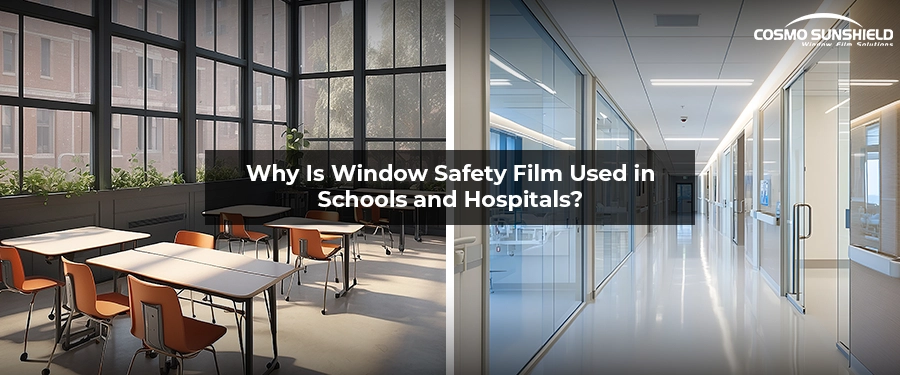
Window safety film is used in schools and
hospitals because both building types combine large glazed areas with occupants
who cannot easily protect themselves: children and patients. Applied to the
interior of existing glass, the film holds shattered fragments in place on impact,
delays forced entry, and blocks UV and infrared heat, all without replacing the
windows.
A storm sends a tree branch
through a classroom window. A cricket ball cracks the pane behind the
playground. A trolley clips a glass partition in a crowded emergency corridor.
None of these are rare events. They are the kind of ordinary, everyday accidents
that happen in any building full of people, and what makes them dangerous is
not the glass breaking, it's what happens the moment after: shards scattering
across a floor where children are sitting, or near a patient's bed, or a
nurse's station.
Schools and hospitals are where this risk is sharpest. Both run at near-full capacity for most of the day, and both are filled with people who cannot move quickly or shield themselves the moment glass gives way. Both have also leaned further into glass than almost any other building type. Nearly every new school block or hospital wing built in India today uses large glazed façades and floor-to-ceiling windows, because natural light and an open, welcoming feel are what architects and administrators want now. That same glass is also the single most fragile part of the building, which is exactly why so many schools and hospitals across India are already making safety film a standard part of how they build.
CONTENT
What Is Window Safety
Film?
Window safety film is a
transparent, multi-layered polyester sheet applied directly to the interior
surface of existing glass. It does not replace the glass or the frame. Once
bonded to the pane, the film acts as a secondary skin: if the glass cracks or shatters,
the fragments stay adhered to the film instead of scattering across a
classroom, corridor, or ward. The same layer also adds tear resistance, which
is what makes forced entry through the glass slower and harder.
It is sold under several names
depending on the market, and all of them describe the same core mechanism.
Safety and security window film is the umbrella term, used for both
injury-prevention and forced-entry applications. Anti-shatter film emphasises
the glass-holding function specifically, and is the term most often used when
the main concern is flying glass rather than intrusion. Shatter-resistant
window film (SRWF) is the more technical, spec-sheet version of the same term,
commonly seen in tender documents and government procurement for schools and
public buildings.
Why Schools and Hospitals
Need Window Safety Film?
Schools and hospitals need window
safety film because both combine large areas of glass, near-constant occupancy,
and people who cannot move quickly or shield themselves if a window breaks:
children in classrooms, patients in wards. That mix of extensive glazing, high
footfall, and vulnerable occupants is what puts these two building types ahead
of a warehouse or a private office on safety film priority:
Extensive glazing Classrooms,
corridors, wards, waiting areas, and reception glazing all maximise natural
light, which means more glass surface exposed to accidents, weather, and
intrusion attempts.
High, constant footfall Both buildings run at near-capacity for most of the day, so any glass failure has a large number of people near it when it happens.
Occupants who cannot self-protect Children in a classroom and patients in a
ward are the two groups least able to move quickly or shield themselves if
glass shatters.
Round-the-clock or
near-continuous operation Hospitals never fully close, and schools cannot pause
classes for a construction project. Any safety upgrade has to work around
occupancy, not the other way round.
Real financial and reputational
stakes A single glass-related injury in a school or hospital carries
consequences no institution wants to explain to a parent, a patient's family,
or a regulator.
Benefits of Window Safety
Film in Schools and
Window safety film benefits schools and hospitals in six main ways: it holds shattered glass together, delays forced entry, protects against storm and impact damage, costs far less than full glass replacement, installs without disrupting daily operations, and adds UV and heat control on top of the safety function.
|
Reason |
What
it means in practice |
|
Holds shattered glass together |
Fragments stay bonded to the film instead
of scattering, cutting the risk of laceration injuries from broken windows. |
|
Delays forced entry |
Intruders need repeated, sustained strikes
to open a hole large enough to get through, buying time for staff to respond
and security to arrive. |
|
Protects against storms and impact |
Hailstorms, high winds, and accidental
impact (a trolley, a cricket ball, a dropped object) are far less likely to
end in a shattered window turning into an open hazard. |
|
Costs a fraction of glass replacement |
Retrofitting film onto existing glass is
significantly cheaper and faster than replacing panes with laminated or
toughened glass across an entire building. |
|
Installs with minimal disruption |
Film goes onto glass that is already in
place. Classes and patient care can continue on the same floor while a
different wing is being treated. |
|
Adds UV, heat, and glare control |
Cosmo Sunshield Safeguard Series blocks a
large share of UV and infrared heat at the same time, a genuine added value
on top of the safety function. |
Window Safety Film for
Schools: Where and Why It Matters
Security film for school windows
in India is used most on ground-floor entry points, classroom and corridor
glazing, and assembly areas, the spots most exposed to accidental impact,
storms, and unauthorised entry. Schools are not uniformly at risk; the vulnerability
sits in a few identifiable places:
For Indian schools specifically,
the case is less about the active-threat scenarios that dominate Western
coverage of this topic and more about a combination of everyday realities:
student activity near glass, monsoon-season storms and hailstorms in the north,
cyclone exposure along the eastern and western coasts, occasional civil
disturbance near urban campuses, and straightforward theft and vandalism after
hours. Film addresses all of these with one retrofit rather than requiring a
different fix for each.
Window Safety Film for
Hospitals: Where and Why It Matters
Hospital glass safety film is
applied most heavily in emergency departments, high-traffic corridors, patient
wards, and pharmacy or records areas, the zones where accidental impact and
theft risk run highest. Hospital glazing carries a different risk profile from
schools, and the strongest approach treats it that way rather than repeating
the same points used for schools:
Hospitals also have a constraint
schools do not: film has to survive the hospital's actual cleaning routine, not
a gentler one. Ammonia-based glass cleaners, common in institutional
housekeeping, break down the adhesive and coating on most window films over
time, causing clouding, lifting at the edges, or premature failure. The fix is
straightforward: specify a film with a scratch-resistant hard coat rated for
repeated cleaning, and have housekeeping switch to a mild, pH-neutral,
ammonia-free glass cleaner on filmed surfaces. That's a one-line change to a
cleaning protocol, not a compromise on hygiene, and it's worth confirming with
whichever film is installed before it goes on hospital glass.
Safety Window Film vs
Bulletproof Glass
Bulletproof glass typically does more of what safety film does, it holds glass together and resists forced entry too, plus it stops certified ballistic threats, a capability film cannot add at any thickness or price. What film offers instead is retrofit coverage: it goes directly onto glass that is already installed, across an entire building, without replacing a single pane.
|
|
Safety
window film |
Bulletproof
glass |
|
What it stops |
Shattering and flying glass; delays forced
entry |
Ballistic projectiles, certified to a
specific threat rating |
|
Installation |
Applied to existing glass, no structural
work |
Full pane and frame replacement, often with
reinforcement |
|
Weight |
Negligible |
Significantly heavier |
|
Typical cost |
A fraction of a full glass replacement |
Multiple times the cost of standard glazing |
|
Best suited for |
Classrooms, corridors, wards, reception
areas, most of a building's glazing |
Cash counters, high-security entries, and
other narrow high-risk points |
What this means for a
school or hospital:
Film handles the everyday risk
these buildings actually face: storms, accidental impact, opportunistic
break-ins, across the whole building.
Bulletproof glass earns its cost
only at the few points where the threat is specifically ballistic, such as a
cash office or a high-security counter.
No vendor should pitch film as a
bulletproof substitute. Choose the right one for each area rather than assuming
one product covers everything.
Safety Film vs Laminated
Glass
|
|
Safety
window film |
Laminated
glass |
|
What it is |
A retrofit layer bonded to existing glass |
New glass manufactured with a bonded
interlayer |
|
Shatter performance |
Holds fragments together on impact |
Holds fragments together on impact, similar
mechanism, factory-built |
|
Installation |
Applied to glass already in place, no pane
removal |
Full pane removal and replacement,
sometimes reframing |
|
Typical cost |
A fraction of new glass and installation |
Full glass and installation cost, higher
per pane |
|
Best suited for |
Retrofitting existing buildings without
construction work |
New construction or a full glazing
replacement project |
Safety film and laminated glass
both hold shattered fragments together on impact, but they get there
differently: film is a retrofit layer applied to glass you already have, while
laminated glass is manufactured with a bonded interlayer and requires replacing
the existing pane. For most schools and hospitals working with buildings that
are already standing, film is the more practical route, and it's the real
comparison to make, not film versus bulletproof glass.
What this means for a
school or hospital:
What Window Safety Film
Does Not Protect Against ?
Window safety film does not stop
bullets, does not stop blasts, and is not a substitute for a full security
plan; it delays and contains damage rather than preventing it outright. No
credible source on this subject oversells the product, and neither should this
one:
Being upfront about this is not a
weakness in the pitch. It is the difference between a school or hospital
administrator trusting the recommendation and dismissing it the moment they
find out the marketing overstated what the product can do.
Where India's Building
Norms Fit In
The National Building Code of
India (NBC) 2016 added a dedicated section, Part 6 Section 8, covering Glass
and Glazing, with specific guidance on human safety where glass is used in
buildings such as schools and public assembly spaces. This built on the "Guidelines
on Use of Glass in Buildings, Human Safety," first published in 2007 by
the Confederation of Construction Products and Services (CCPS) with industry
backing. The Bureau of Indian Standards later used those guidelines as the
basis for IS 16231 (Part 4):2014, a formal code of practice on glass safety
related to human impact. The CCPS guidelines themselves have already been
adopted through government orders by more than twenty states and central
agencies, including Central PWD, the governments of Andhra Pradesh and
Rajasthan, NBCC, the Airport Authority of India, Haryana PWD, and the Delhi
Development Authority.
None of this requires a school or
hospital to rip out existing glazing to comply. Safety film is a widely
recognised, retrofit-friendly way to bring existing annealed glass closer to
the intent of these human-safety provisions without the cost or downtime of a
full glazing replacement. For institutions pursuing accreditation or working
through fire and life safety compliance under NBC Part 4, addressing
glass-related occupant risk in high-footfall areas is one part of that broader
picture.
How to Choose Window Safety
Film for a School or Hospital?
Choosing window safety film for a
school or hospital comes down to four checks: tensile strength for impact and
forced-entry resistance, visible light transmission for how bright the space
needs to stay, added layers like UV protection and scratch resistance, and
installer credibility backed by a real warranty. A school or hospital should
not choose on price alone:
Cosmo Sunshield Safeguard Series is built
around exactly this checklist. It comes in multiple variants and is up to 7
mil, so a school and a hospital, or even two departments within the same
hospital, can choose a different balance of strength and clarity: some variants
are engineered for up to 29,000 psi tensile strength for maximum impact and
forced-entry resistance, while others prioritise clarity with up to 90% visible
light transmission for spaces that need to stay bright. Across the range,
Safeguard combines shatter resistance, scratch resistance, anti-graffiti
protection, UV protection, and IR heat rejection in a single application, so
one film addresses safety, durability, and energy performance together.
For a school choosing film for
ground-floor classrooms and entry doors, a higher-tensile-strength variant is
usually the priority. For a hospital balancing security with a bright, calming
patient environment, a high-VLT variant may be the better fit, with a
higher-strength option reserved for the pharmacy, records room, and other
higher-risk zones.
Why Window Safety Film
Makes Sense for Schools and Hospitals ?
For schools and hospitals, glass safety is not just about protecting
windows, it's about protecting the people who use these spaces every day.
Accidental impact, storms, forced entry, and everyday wear can all turn a
broken window into a serious hazard.
Window safety film offers a
practical way to reduce that risk without replacing existing glazing. By
holding shattered glass together, delaying forced entry, and adding UV, heat,
and surface protection, a single retrofit covers several layers of value at
once.
The right choice still depends on
where it's going in. Schools tend to prioritise impact resistance around
classrooms, corridors, and entry points, while hospitals often need a mix of
security, clarity, durability, and hygiene compatibility across different
departments. Cosmo Sunshield Safeguard Series is built to cover that range,
from high-strength variants for entry points to high-clarity variants for
patient-facing spaces.
For any institution looking to
improve glass safety without major structural work, window safety film is a
practical part of a broader safety and security strategy. When a pane of glass
does fail, what matters most isn't just whether it breaks, but what happens
next.
Window Safety Films FAQs
1. Why is window safety film
used in schools?
Schools use window safety film to
reduce injury risk from broken glass, slow down unauthorised entry through
ground-floor windows and doors, and protect classrooms and corridors from storm
and accidental impact, all without replacing existing windows.
2. Why is window safety film
used in hospitals?
Hospitals use window safety film
to protect high-traffic corridors, patient rooms, and sensitive areas like
pharmacies and records rooms from accidental impact, break-ins, and
glass-related injury, while staying compatible with hygiene and cleaning protocols.
3. Is window safety film
bulletproof?
No. Window safety film is not
certified as bullet-resistant on its own. It is designed to hold shattered
glass together and delay forced entry, not to stop ballistic impact.
4. Can window safety film stop
a break-in completely?
It cannot guarantee that. It
significantly slows down forced entry by requiring repeated strikes to breach
the glass, which buys valuable time for a response but does not make a break-in
impossible.
5. Does window safety film
help during storms or natural disasters?
Yes. It holds glass together
against wind-driven debris and hailstorm impact, and it reduces the amount of
flying glass if a window does break during a storm or seismic event.
6. How is window safety film
different from tinted or heat-control film?
Standard heat-control or tinted
film is designed mainly for solar heat and glare reduction. Safety film adds a
tear-resistant layer specifically engineered to hold broken glass together and
resist forced entry, though many safety films, including Cosmo Sunshield
Safeguard Series, provide heat and UV control as well.
7. Does Cosmo Sunshield
Safeguard Series reduce heat and glare too?
Yes. Along with its impact and
shatter resistance, Cosmo Sunshield Safeguard Series blocks up to 95% of
infrared heat and over 99% of UV rays, helping cut cooling costs alongside the
safety benefit.
8. Does window safety film
need the glass to be replaced first?
No. It is applied directly to
existing glass. That is the main reason institutions choose it over full
glazing replacement or laminated glass.
9. How does the cost of safety
film compare to laminated or bulletproof glass?
Safety film costs a fraction of
replacing windows with laminated or bullet-resistant glass, since it retrofits
onto the glass that is already installed rather than requiring new panes and
frame work.