Paint Protection Film
Nissan Tekton PPF Guide 2026: Cost, Coverage & Your First 30 Days
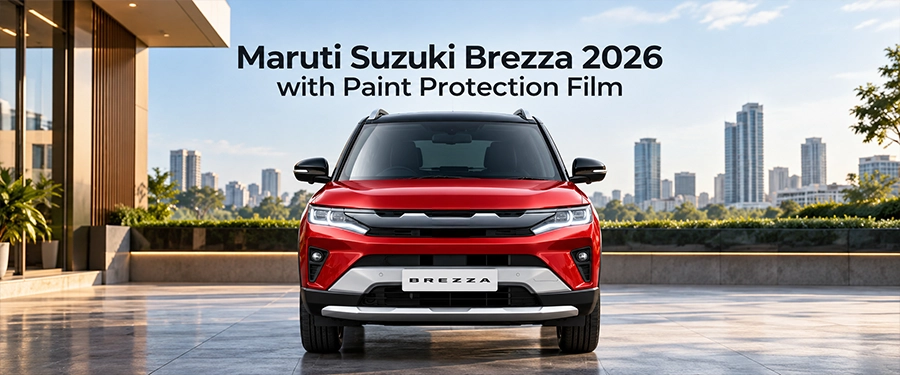
PPF on a 2026 Maruti Suzuki Brezza costs roughly ₹15,000 to ₹1.2 lakh in India, depending on coverage. A front kit (₹15,000 to ₹28,000) protects the front bumper, bonnet edge, fender edges, mirror caps, door cups and door edges, where most city damage lands. Full front (₹32,000 to ₹48,000) suits highway and high-mileage drivers, and full body (₹75,000 to ₹1.2 lakh) suits long ownership or heavy highway use. A dual-tone roof can be added to any package. The best time to fit it is before regular driving starts.
On delivery day, a new Maruti Suzuki Brezza is in the best condition it will ever be. The paint should be flawless, with the clear coat intact and no chips or scratches on any panel.
That condition does not last long on Indian roads. Stones thrown up by trucks chip the bonnet and front bumper. Tight parking spaces scuff the bumpers and door edges. Luggage and shopping scratch the boot lip. None of this damage is a manufacturing defect, so the warranty does not cover it, and every repair means touch-up paint or polishing that removes more of the original finish.

Paint protection film (PPF) prevents this damage instead of repairing it. It is a clear film applied over the paint that helps absorb the impact of road debris and resist scratches, and the best films also self-heal light marks. This guide explains what PPF for the Maruti Suzuki Brezza costs in 2026, which panels to cover first, how to choose the right type of film, and what to do in the first 30 days of ownership to keep the factory finish intact.
Table of contents
2026 Maruti Suzuki Brezza at a Glance
The facelifted Brezza launched on 24 July 2026. It keeps its sub-four-metre footprint, which matters for PPF because a smaller car takes less film and costs less to cover than a larger SUV.
|
Detail |
2026 Maruti Suzuki Brezza |
|
Launch |
24 July 2026 |
|
Ex-showroom price |
₹7.40 lakh to ₹13.55 lakh |
|
Trims |
LXi, VXi, ZXi, ZXi+ |
|
Engines |
1.0-litre Turbo Boosterjet petrol (6-speed manual only); 1.5-litre
K15C petrol (6-speed manual or automatic); 1.5-litre S-CNG (6-speed manual) |
|
CNG tank |
Underbody-mounted on the 2026 model |
|
Colours |
Pearl Arctic White, Splendid Silver, Magma Grey, Bluish Black,
Sizzling Red, Vivacious Orange (new), Lustrous Beige (new); dual-tone black
roof on White, Red and Beige in select trims |
Does the Brezza Need PPF?
Yes, for the panels that take repeated contact. Automotive clear coats are often only around 35 to 50 microns thick, depending on the paint system. Clear coat does not grow back once a stone chip, key scratch or wash swirl removes part of it, and every repair after that means touch-up paint or polishing that takes off more of it.
Maruti Suzuki's standard warranty runs 3 years or 1,00,000 km and covers manufacturing defects. Chips and scratches from everyday driving are not manufacturing defects, and Maruti's extended warranty terms specifically list paintwork and bodywork as not covered. PPF fills that gap. It is a protective film applied over the paint that helps absorb the impact of road debris and resist scratches. Self-healing properties depend on the film.
Daily use in Indian cities adds up quickly. Tight basement parking, two-wheelers filtering past door edges, gravel on expressways and regular boot loading all mark a compact SUV faster than a car that sits in a garage. None of this is a flaw in the Brezza. It is how the segment gets used.
Brezza PPF Price in India (2026)
PPF for a Maruti Suzuki Brezza costs about ₹15,000 to ₹1.2 lakh, depending on how much of the car is covered. The table below uses indicative pricing for Cosmo PPF Platinum.
|
Package |
Panels covered |
Indicative price (Cosmo PPF Platinum) |
Share of Brezza price |
|
Front kit (high-impact) |
Front bumper, bonnet leading edge, fender edges, mirror caps, door
cups, door edges |
₹15,000 – ₹28,000 |
About 1–4% |
|
Full front |
Full bonnet, full fenders, front bumper, mirror caps, headlamp
surrounds, door cups and edges |
₹32,000 – ₹48,000 |
About 2.5–6.5% |
|
Full body |
Every painted exterior panel, including doors, rear quarters, boot lid
and roof |
₹75,000 – ₹1.2 lakh |
About 5.5–16% |
|
Add-ons |
Boot lip / rear bumper loading area; dual-tone roof |
Quoted separately |
– |
Three things move the final price:
Prices are indicative for 2026 and vary by city and installer. Ask a Cosmo PPF installer for an exact quote.
Get a Brezza PPF quote from a Cosmo PPF installer
Which Brezza Panels Should Be Covered First?
In order of how often they take damage in normal use:
How to Choose the Right PPF for Your Brezza

Choosing PPF comes down to two decisions: how much of the car to cover, and which film to use. Here are the factors that decide each one.
1. How much of the car to cover
Coverage depends less on the car and more on how it is driven and how long it will be kept:
2. Which type of PPF to choose
Not all PPF is the same. Two films can look identical on day one and perform very differently after two Indian summers. These are the factors that separate a good film from a poor one:
|
|
TPU |
TPH |
PVC |
|
Self-healing |
Yes, heat-activated (premium films) |
Minimal to none |
Generally none |
|
Yellowing / UV resistance |
Generally resistant (aliphatic grades) |
Can turn milky or yellow from 18–24 months |
Generally lower |
|
Flexibility on curves |
Generally high |
Moderate |
Generally lower |
|
Impact absorption |
Generally high |
Moderate |
Generally lower |
|
Typical lifespan |
Varies by film; premium TPU is typically backed by long warranties |
About 2–3 years |
Generally shorter than TPH |
|
Removal |
Generally clean with a quality adhesive |
Varies |
Varies |
|
Price |
Generally higher |
Lower |
Lowest |
|
Best for |
Owners keeping the car long-term |
Short-term, budget use |
Temporary protection only |
A low quote can mean a TPH or PVC film sold simply as "PPF". Before you book, ask the installer which material the film is made of and to show you the manufacturer's warranty terms.
Does a CNG Brezza Need Anything Different?
No. The PPF requirements are the same for the petrol and CNG versions, because PPF is applied to the painted exterior panels. The only thing that changes the advice is distance. If the car covers high annual mileage, especially on highways, front-end exposure rises and full front becomes worth considering over a front kit. That applies to any Brezza, whatever the fuel.
Your First 30 Days With a New Brezza: A Checklist

The first month decides a lot about how your Brezza looks and runs for years. Paperwork, the first service and paint protection all fall in this window, and PPF is cheapest to fit now, while the paint needs no correction. Use this checklist to stay on top of it.
On delivery day
Week 1: protect the paint before daily driving starts
Weeks 2–4: settle in and stay on schedule
By day 30
Why PPF belongs in week 1
Every other task on this list can wait a few days. Paint can't. Once daily driving starts, the front bumper, bonnet edge and door edges begin collecting chips and scratches that film can only cover up, not undo.
Fitting PPF on a Brezza You Already Drive
Film still works on an older Brezza, but the order changes. PPF is optically clear, so it preserves whatever the paint looks like on the day it is fitted, chips and swirl marks included. A paint inspection comes first.
A good installer recommends correction only on the panels that need it, since polishing removes clear coat that doesn't come back. The practical approach is to correct and film the panels that matter most (bonnet, front bumper and door edges) rather than the whole car.
Why Cosmo PPF Platinum for the Brezza?
On a Brezza the bigger decision is how much of the car to cover. The film still decides how that coverage looks and lasts. Cosmo PPF Platinum is built for long ownership:
For owners with a tighter budget, a front kit in Cosmo PPF Gold+, Gold or Silver is available at lower price points. Your installer can compare tiers for your Brezza.
Complete Protection: Glass, Cabin and Unfilmed Panels

PPF protects paint. Two other Cosmo products cover what it doesn't:
Final Thoughts
The best Brezza PPF package depends on how the car is driven and how long it will be kept. For mostly city use, a front kit protects the panels that take the most damage. Highway or high-mileage owners are better served by full front, and full body earns its cost with long ownership or heavy highway use. Whichever you choose, fitting it before regular driving starts means the film seals in factory paint rather than preserving marks.
Protect your Brezza
Find a Cosmo PPF installer and get a quote for your Brezza: Request a quote | Contact us
Frequently asked questions about Brezza
1. How much does PPF cost for a Maruti Brezza?
About ₹15,000 to ₹1.2 lakh in 2026. A front kit costs ₹15,000 to ₹28,000, full front ₹32,000 to ₹48,000 and full body ₹75,000 to ₹1.2 lakh (indicative, Cosmo PPF Platinum). Being a sub-four-metre car, the Brezza takes less film than a larger SUV.
2. Is PPF worth it on a Brezza?
Yes, on the panels that take repeated contact. Clear coat doesn't regrow once it is chipped or scratched, and Maruti's warranty covers manufacturing defects, not damage from everyday driving. A front kit protects the areas that take the most damage for about 1–4% of the car's price.
3. Is full-body PPF worth it for a Brezza?
It depends on use. Full body makes most sense for heavy highway driving or long ownership. For mostly city driving and three to five years of ownership, a front kit or full front covers where damage actually lands. A dual-tone roof can be added to any package.
4. Which PPF is best for a Brezza?
For long ownership, a self-healing, non-yellowing film with a long warranty. Cosmo PPF Platinum is 8.5 mil (about 216 microns) Lubrizol TPU with Ashland Advance PS adhesive and a lifetime warranty. Gold+, Gold and Silver tiers suit tighter budgets.
5. Which parts of a Brezza should be covered first?
The front bumper, bonnet leading edge, door edges and cups, fender edges and mirror caps. Add the boot lip if the boot is loaded often, and the roof on a dual-tone car.
6. Does installing PPF affect the Maruti Suzuki warranty?
PPF is applied to the exterior paint and does not modify the vehicle's mechanical or electrical systems. However, warranty terms can vary, so check Maruti Suzuki's current warranty conditions and use an installer who follows the manufacturer's paint and installation guidelines.
7. Will PPF turn yellow on a white or silver Brezza?
Not with a non-yellowing film. Yellowing comes from low-grade film chemistry and shows first on light colours. Cosmo PPF Platinum is non-yellowing.
8. Does self-healing PPF actually work?
Yes, on light scratches and swirl marks, which fade with heat. Deep cuts that reach the paint, and tears in the film, don't self-heal.
9. Can PPF be fitted on an older Brezza?
Yes, after a paint inspection. Existing chips and swirls stay visible under clear film, so the panels that need it are corrected first, which adds cost.
10. Can PPF be removed without damaging the paint?
Yes, on sound factory paint, by a trained installer using controlled heat. Panels that were repainted carry more risk.
11. How long does PPF installation take on a Brezza?
A front kit usually takes a day, full front one to one and a half days, and full body two to three days. Paint correction adds time.
12. Which is better for a Brezza: TPU, TPH or PVC PPF?
TPU, for most owners. Premium TPU films are flexible, resist yellowing and offer heat-activated self-healing. TPH offers minimal to no self-healing, and most TPH films begin to turn milky or yellow after 18 to 24 months of sun exposure. PVC is the most basic option.