Window Film
Car Window Tint in India: Types & Installation

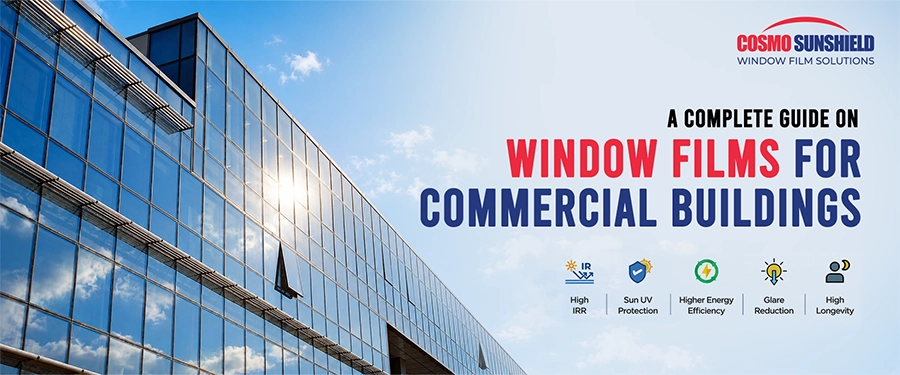
Discover how commercial window film reduces energy costs, blocks UV rays, and improves comfort in office buildings. Learn why Cosmo Sunshield is India's trusted choice for commercial window film solutions.
India is one of the hottest countries in the world, and its commercial buildings are paying the price for it every single month. According to the US Department of Energy, untreated glass facades account for 30 to 40% of a commercial building's total cooling load. In cities like Delhi, where summer temperatures regularly cross 45°C, the average commercial building wastes 20% of its annual energy budget purely because of heat gain through untreated glass. That is not a maintenance problem. That is a structural inefficiency that compounds silently, year after year, while the real fix remains one of the most overlooked solutions in the industry.
High-performance commercial window film blocks up to 95% of infrared heat, eliminates over 99% of UV radiation, and cuts annual cooling costs by 10 to 20%, without replacing a single pane of glass. This guide explains how it works and why Cosmo Sunshield is the name architects, developers, and facility managers across India are turning to.
What Is Window Film and How Does It Work?
Window film is a thin, multi-layered polyester or nano ceramic film applied to the interior surface of existing glass. It selectively filters the solar spectrum and lets natural light in while keeping heat, UV rays, and glare out.
To understand how window film filters the solar spectrum without blocking natural light, you need to understand what sunlight actually is. It is not just light rather it is a spectrum of three very different types of energy hitting your glass simultaneously:
And it does all of this without replacing a single pane of glass.
Why is Window Film Not the Same as Window Tinting?
Basic window tinting works by darkening the glass to reduce light and heat reduction is a side effect, not an engineered outcome.
High-performance commercial window films are fundamentally different. Using nano ceramic technology, it can reject up to 95% of infrared heat while still transmitting 70% of visible light. The glass does not need to go dark to perform. This distinction is critical for commercial buildings where natural light, aesthetics, and occupant experience all matter equally.
Why Indian Commercial Buildings Need Window Film More Than Anywhere Else
India presents a solar challenge most other markets simply do not face at the same intensity.
The Unique Solar Load Challenge of Indian Cities
How Delhi, Mumbai, Hyderabad and Chennai Compare in Solar Intensity
|
City |
Primary Challenge |
Peak Season |
|
Delhi |
Extreme dry heat, 44–46°C peaks,
intense south/west exposure |
April to June |
|
Mumbai |
High heat + high humidity
year-round, continuous AC stress |
Year-round |
|
Hyderabad |
Extended high sun angles, strong
afternoon west-facing load |
March to October |
|
Chennai |
Long solar season, high
humidity, persistent east and west load |
February to November |
Glass-Heavy Architecture and the Energy Efficiency Gap It Creates
Modern commercial buildings in India have embraced glass facades since they look impressive, allow natural light in, and project a contemporary image.
The problem is that most commercial glass in India has no solar control. Clear or lightly tinted glass, which describes most of the commercial glazing installed over the past two decades, transmits the bulk of the solar spectrum directly into the occupied space. The result is an energy efficiency gap that shows up on the electricity bill every single month.
Window film addresses this directly by reducing glass surface temperature and blocking infrared energy before it enters the building.
Window Film vs Other Solar Control Solutions for Commercial Buildings
Before committing to window film, let's understand how it is compared against the alternatives.
Window Film vs Window Replacement
Verdict: Window film delivers equivalent performance at a fraction of the cost, with zero structural disruption.
Window Film vs Reflective Glass
Reflective glass is fixed once installed; it cannot be upgraded or adjusted. Window film can be specified, upgraded, or replaced at any point in the building's lifecycle without touching the glass. For most retrofit projects, window films are the more flexible and cost-effective choice.
Window Film vs External Shading
External shading systems like louvres, fins, canopies are architecturally effective but:
Window film provides continuous solar control across the full glass surface with no maintenance beyond standard cleaning.
Window Film vs Smart Glass
Smart glass is impressive technology, and it comes with a price tag to match. For most Indian commercial buildings, the capital investment is difficult to justify purely on energy savings. High-performance window films deliver 80 to 90% of the thermal benefit at a fraction of the cost, making it the practical choice for performance-driven projects.
Introducing Cosmo Sunshield: India's Benchmark in Architectural Window Films
When selecting a window film partner for commercial projects in India, Cosmo Sunshield stands in a category of its own.
Four Decades of Specialty Film Expertise Behind Every Product
Cosmo Sunshield is a window film brand of Cosmo First which is backed by over four decades of leadership in specialty films and advanced materials science. It is a manufacturer with technical depth to develop, refine, and stand behind every product it produces.
Why Cosmo Sunshield Priorities Infrared Rejection Over Total Solar Energy Rejected
Most brands lead with TSER (Total Solar Energy Rejected) which is a broad metric that can be inflated simply by blocking more visible light.
Cosmo Sunshield leads with IRR (Infrared Rejection) and it is the metric that directly measures how much heat is blocked. The difference matters because:
Nano Ceramic Technology: What It Is and Why It Matters for Commercial Spaces
The Ultra Cool Series uses Nano Ceramic and Active Ceramic technology — the most advanced film construction available commercially. Nano ceramic particles dispersed at a molecular scale deliver:
Cool View, Rainbow and Ultra Cool : Which Cosmo Sunshield Series Fits Your Building?
Cosmo Sunshield offers three distinct series for commercial and residential applications, each built for a specific set of performance requirements, aesthetic preferences, and budget considerations. Choosing the right one starts with understanding what your building needs.

Ultra Cool Series — Nano Ceramic, High IRR, Low Reflectivity
|
Variant |
VLT |
IRR |
TSER |
Glare Reduction |
Best For |
|
Ultra Cool 7090 |
70% |
90% |
49% |
22% |
Open plan offices, lobbies,
reception areas |
|
Ultra Cool 5095 |
50% |
95% |
51% |
42% |
South/west-facing facades,
meeting rooms |
|
Ultra Cool 1595 |
15% |
95% |
63% |
82% |
Boardrooms, executive offices,
ground floor retail |
|
Ultra Cool 0595 |
5% |
95% |
68% |
93% |
Utility glazing, server rooms,
maximum blocking |
Key benefit across the entire series: Over 99% UV rejection, Wi-Fi-friendly, low indoor reflectivity for clear outside views at night.
Cool View Series — Reflective Film for Modern Facades
For commercial projects where a sleek, polished exterior is part of the architectural vision:
Delivers strong daytime privacy alongside serious thermal and UV performance which is ideal for ground-floor commercial spaces, meeting rooms, and glass-heavy facades.
Rainbow Series — Nano Pigment, Non-Reflective, High Privacy
For spaces where reflective films are not permitted or simply not preferred, the Rainbow Series delivers dependable heat control without the mirrored exterior look.
|
Variant |
VLT |
UV Rejected |
Heat Rejected |
TSER |
Glare Reduction |
Best For |
|
CS-300-P 0577 |
5% |
99% |
78% |
61% |
94% |
Maximum privacy, high solar load spaces |
|
CS-300-P 1463 |
14% |
99% |
66% |
53% |
84% |
Boardrooms, ground floor offices, retail |
|
CS-300-P 3640 |
36% |
99% |
44% |
36% |
51% |
Residential rooms, moderate heat control |
Key benefits across the series: Over 99% UV rejection, non-reflective finish, up to 95% privacy, and an accessible price point that makes professional grade solar protection available across a wider range of projects.
Explore the full range of Cosmo Sunshield Architectural Window Films to find the right specification for your building.
What to Look for When Choosing a Commercial Window Film

Before specifying a film, run through these five checkpoints:
Commercial Window Films Frequently Asked Questions
1. What is window film?
Window film is a thin, multi-layered nano ceramic or polyester film applied to existing glass. It blocks infrared heat, UV rays, and glare while preserving natural light.
2. How to install window films?
Professional installers clean the glass, cut the film to precision dimensions, apply it with a slip solution, and squeegee out all air and moisture for a clean, bubble-free finish. It is always recommended to get professional installation and is always recommended to ensure warranty validity and specification-grade results.
3. How much does window film installation cost?
Cost varies based on film specification, total glass area, and building access. Premium nano ceramic films represent a higher upfront investment but deliver better performance, longer life, and faster ROI through energy savings.
4. What is solar control window film?
Solar control window film is engineered to manage solar energy transmission through glass. Selectively blocking infrared and UV while maintaining high visible light transmission.
5. Which window film is best for commercial buildings in India?
For most Indian commercial buildings, a high-IRR nano ceramic film delivers the best combination of heat control, natural light, and energy savings.
6. How much heat does window film block in offices?
Cosmo Sunshield Ultra Cool films block up to 95% of infrared radiation, reducing indoor temperatures by 3 to 6°C in directly sunlit spaces and 5 to 7°C across broader occupied areas. Read our guide on how window films can instantly lower indoor temperatures for the full breakdown.
7. Can window film reduce AC bills in commercial spaces?
Yes. By lowering the infrared heat entering through glass, window film reduces air conditioning load significantly.
Still comparing window films against traditional window treatments?
Our guide on why sun protection film outperforms curtains and blinds covers the full comparison in practical terms.
Ready to explore the right specification for your building?
Visit the Cosmo Sunshield Architectural Window Films page or get in touch with our team for a tailored recommendation.