Window Film
Residential Window Film: Types, Benefits and Why Your Home Needs It

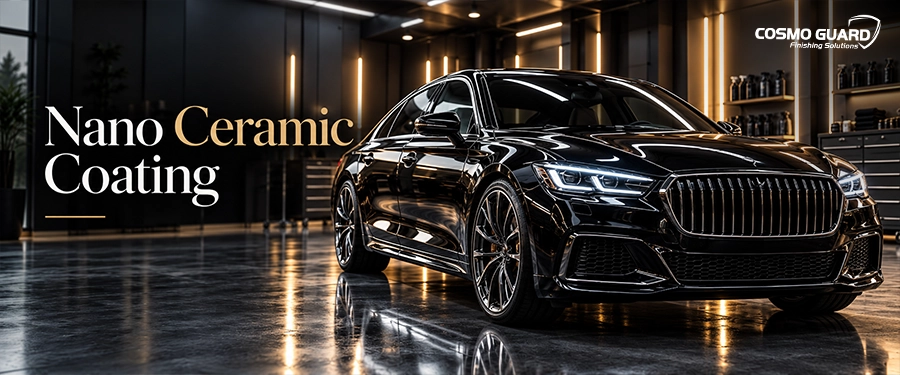
Nano ceramic coating is a liquid protective layer applied to a car’s paint. It bonds with the clear coat at a microscopic level and cures into a hard, transparent finish. It deepens the gloss, repels water and dirt, and shields the surface from sunlight, rain and pollutants. This guide covers what nano ceramic coating is, how it works, where it can be applied, how the process runs, how to care for it and the questions car owners in India ask most often.
What Is Nano Ceramic Coating?

What does "nano" mean?
A nanometre is one billionth of a metre. The term "nano" is generally used for particles smaller than 100 nanometres, while a single human hair is roughly 80,000 nanometres wide. At this size, particles are small enough to settle into the microscopic pores and uneven areas of a paint surface, which look smooth to the eye but are not smooth up close
Nano ceramic coating is a surface protection product made of nano-scale particles, most commonly silica-based, suspended in a liquid carrier. “Nano” refers to the particle size, which is small enough to settle into the microscopic pores and uneven areas of a paint surface. Once applied and cured, the particles form a thin, glass-like layer that sits on top of the clear coat.
You will often see a hardness rating of 9H mentioned with these coatings. This refers to the pencil hardness scale, where 9H is the highest grade. It indicates a hard cured surface that holds up well against everyday contact, such as light dust wiping and washing.
Nano ceramic coating is different from wax and polish. Wax sits on the paint and is gradually washed away. A ceramic coating bonds to the paint and becomes a lasting part of the surface.
How Does Nano Ceramic Coating Work?
The coating works through four connected effects.
Cosmo Guard nano ceramic coating is built on this approach. It combines nano-scale precision with 9H hardness protection, and it is developed through the R&D investments of Cosmo First Limited for harsh driving conditions.
Benefits of Nano Ceramic Coating

The coating enhances the depth and clarity of the original paint, giving the car a deep, reflective shine that holds the showroom finish.
Sunlight is one of the main reasons paint turns dull over time. A ceramic layer helps guard against fading and oxidation.
Rain, dust and pollutants meet the coating first instead of the paint.
The hard cured layer resists the fine marks and swirl patterns that regular washing can leave behind.
Because water and dirt slide off, cleaning takes less time and effort, and the car stays clean for longer between washes.
Resistance to chemical stains and contaminants. Bird droppings, tree sap, insect residue and acidic road contaminants can etch into unprotected clear coat. A coated surface keeps them on top of the layer instead of letting them settle into the paint, so they are easier to remove and less likely to leave marks.
A well-kept coating reduces the need for frequent polishing and paint touch-ups, and a car with well-preserved paint is easier to present at the time of resale.
Why Nano Ceramic Coating Suits Indian Conditions
Indian roads and climates put paint through a wide range of conditions, and a coating addresses many of them.
Hard water across many cities: Mineral deposits from washing and rain can leave marks that a smooth coated surface does not hold on to as easily.
Where Can Nano Ceramic Coating Be Applied?
Paint is the most common application, but the coating is used across the car.
It suits new cars, which can be coated to preserve the factory finish from the start, and older cars, where the paint is first corrected so the coating sits on a clean and even surface.
Nano Ceramic Coating Application Process

The result depends on how well the surface is prepared and how carefully the coating is applied. A proper process includes these steps.
1. Wash and decontamination: The car is washed thoroughly, and embedded contaminants are removed with clay and iron removal products.
2. Paint correction: Rubbing compound levels surface imperfections, and polishing compound refines the finish and lifts the gloss.
3. Surface preparation: An isopropyl alcohol wipe removes oils and polishing residue so the coating can bond directly.
4. Coating application: The coating is applied panel by panel in controlled sections and levelled evenly.
5. Curing: The coating is allowed to cure in a dust-free environment, and the owner is given specific aftercare instructions.
Professional application is important because every step affects the final finish. Cosmo Guard coatings are applied by certified experts, and the range includes rubbing and polishing compounds so that preparation and protection come from one system.
How Long Does Nano Ceramic Coating Last?
Durability depends on several factors:
A coating that is applied well and maintained properly protects the paint for a long period, and the exact duration varies from car to car. Ask your installer what to expect for your specific car and usage.
Care and Maintenance Tips
A few simple habits help the coating perform at its best.
Nano Ceramic Coating vs Wax vs Sealant vs Polymer Coating
|
Feature |
Nano Ceramic Coating |
Wax |
Paint Sealant |
Polymer Coating |
|
How it attaches |
Chemical bond with the clear coat |
Sits on the surface |
Bonds loosely to the surface |
Bonds loosely to the surface |
|
Durability |
Long-lasting |
Short-term |
Medium-term |
Medium-term |
|
Gloss |
Deep, mirror-like |
Warm, soft shine |
Sharp, clean shine |
Sharp, clean shine |
|
Water behaviour |
Strong beading and sheeting |
Moderate beading |
Good beading |
Good beading |
|
Hardness |
High, up to 9H |
None |
Low |
Low to moderate |
|
UV and oxidation protection |
High |
Limited |
Moderate |
Moderate |
|
Maintenance effort |
Low |
Frequent reapplication |
Periodic reapplication |
Periodic reapplication |
Wax is a quick way to add warmth to the paint for a short period. Sealants and polymer coatings extend protection for a few months. Nano ceramic coating is the choice for owners who want a hard, lasting layer with strong water repellency and UV resistance.
Nano Ceramic Coating: Myths vs Facts
Myth: It is only for new cars.
Fact: It suits new and older cars. New cars gain a protected finish from day one, and older cars regain depth and gloss once the paint is corrected before coating.
Myth: It is just an expensive wax.
Fact: Wax sits on the paint, while a ceramic coating bonds with the clear coat and forms a hard, lasting layer with a rating of up to 9H.
Myth: It only adds shine.
Fact: Gloss is one benefit. The coating also brings UV and oxidation resistance, weather protection, hydrophobic behaviour and scratch and swirl resistance.
Myth: It makes washing more complicated.
Fact: Washing becomes quicker and easier because water, dust and dirt slide off the slick surface.
Myth: It is only meant for paint.
Fact: It can also be applied on wheels, glass, trims and headlamps for a complete finish.
What Affects the Cost of Nano Ceramic Coating?
Pricing depends on the following factors, and quotes vary by car and by city.
When comparing, consider the value over time. A coating reduces the need for repeated waxing, frequent polishing and paint restoration.
Frequently Asked Questions
1. What is nano ceramic coating?
Nano ceramic coating is a liquid protective layer that bonds with a car’s clear coat and cures into a hard, glossy, water-repellent finish. It is made of nano-scale particles that fill microscopic gaps in the paint, and it protects against UV rays, weather and everyday contaminants.
2. How long does nano ceramic coating last?
Nano ceramic coating lasts for a long period, and the exact duration depends on the number of layers, climate, usage and maintenance. Proper application and regular care help the coating perform for longer.
3. Is nano ceramic coating worth it in India?
Yes, nano ceramic coating is worth considering for Indian conditions. Strong sun, monsoon rain, dust, hard water and coastal air all affect paint, and a ceramic layer helps protect the finish while making cleaning easier.
4. Can nano ceramic coating be applied on a new car?
Yes, a new car is one of the best candidates for nano ceramic coating. Applying it early preserves the factory finish and gives the paint protection from the start.
5. Can nano ceramic coating be applied on an older car?
Yes, older cars can be coated after the paint is corrected. Correction levels imperfections so the coating bonds to a clean surface and restores depth and gloss.
6. How is nano ceramic coating different from wax?
Nano ceramic coating bonds chemically with the paint, while wax only sits on top. This gives the coating greater hardness, longer-lasting protection and stronger water repellency.
7. Does nano ceramic coating protect against UV rays?
Yes, nano ceramic coating offers UV and oxidation resistance. It helps guard the paint against fading and dullness caused by prolonged sun exposure.
8. Can I wash my car at home after using nano ceramic coating?
Yes, home washing is fine once the installer’s curing period is over. Use a pH-neutral shampoo, clean microfibre mitts and a soft drying towel.
Protect Your Paint with Cosmo Guard
Nano ceramic coating gives a car lasting gloss, weather protection and easier upkeep, and the results depend on quality products and skilled application. To get a nano ceramic coating for your car, request a quote for Cosmo Guard through the Cosmo Consumer contact page.