Window Film
Car Window Tint in India: Types & Installation
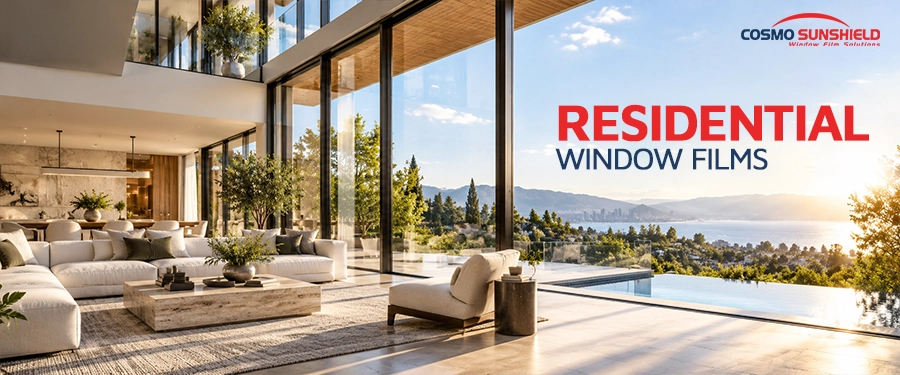
Residential window film is a thin layer on home glass that cuts heat, glare and UV, adds privacy and can hold broken glass together. The main types are heat control, reflective, privacy and decorative, safety and security, and UV-blocking film. Cosmo Sunshield covers heat, privacy and safety with UltraCool, Luster and Safeguard Series.
Walk into a sun-facing room at 3 pm in May and the problem is obvious. The glass is doing what glass does, which is let the sun in. Curtains get drawn, the AC drops another degree and the room goes dark to stay cool.
Most homes accept that trade, and it is a poor one. Daylight is a big reason people choose large windows in the first place. Window film keeps the light and deals with the heat, glare and UV before they reach the room.
No single film suits every window, though. A hot west-facing living room, a bedroom facing a neighbour and a balcony door with children nearby all need different things. That is why residential film comes in different types, each built for a different job.
In this guide
What Is Residential Window Film and How Does It Work?
Residential window film is a thin, clear or tinted layer applied to a window pane. It filters sunlight by blocking most UV, rejecting a share of infrared heat and softening visible glare, so rooms stay cooler and furniture fades more slowly, without replacing the glass.
Window film also goes by names such as glass film, sun control film, solar film and home window tint in India. All describe the same idea: a layer on the glass that manages sunlight.

Sunlight is not just light. Cosmo’s solar spectrum guide splits it roughly into 44% visible light, 53% infrared and 3% UV. Infrared is the heat you feel on your skin. UV is invisible and drives fading in curtains, carpets and furniture. Visible light is the part you want to keep.
More than half of the sun’s energy is the part you cannot see. Film is engineered to reject as much of that invisible share as possible while letting visible light through. A handful of numbers show how well it does that.
|
Term |
What it tells you |
|
VLT (Visible Light Transmission) |
How much daylight passes through the
glass and film. Higher means a brighter room. |
|
UV rejected |
The share of UV blocked. All three
Cosmo Sunshield residential series block over 99%. |
|
IR heat rejected |
The share of infrared heat blocked.
Higher means less heat entering the room. |
|
TSER (Total Solar Energy Rejected) |
The share of all solar energy kept
out, counting visible light, infrared and UV together. |
|
Glare reduction |
How much brightness and eye
discomfort is cut. |
|
SHGC (Solar Heat Gain Coefficient) |
The fraction of solar heat that gets
in. Lower means better heat control. |
|
U-value |
How easily heat flows through the
glass and film. Lower means better insulation. |
Why Do Homes Need Window Film?
Homes need window film because glass lets in more heat, glare and UV than most rooms can handle. Film cuts that load, protects furniture and floors, adds privacy without heavy curtains and, in safety versions, holds broken glass together. Rooms stay more comfortable with less strain on the AC.

Glass is the weakest point in a home’s defence against the sun. A clear pane lets most of the sun’s energy through, and sun-facing rooms in much of India can stay hot for months. Curtains and blinds help, but they work by shutting out daylight. Film works on the glass itself, so the view and the brightness largely stay.
What Are the Types of Residential Window Film and Why Are They Needed?
Residential window film comes in five main types: heat control, reflective, privacy and decorative, safety and security, and UV-blocking clear film. Each exists because one window problem needs a different film. Picking the type that matches the problem matters more than picking the darkest film.
|
Type |
How it works |
Why homes need it |
Watch out for |
|
Heat control (solar control) film |
Ceramic, nano ceramic or spectrally
selective layers reject infrared heat while letting visible light through |
Sun-facing rooms stay cooler and the
AC works less |
Heat rejection varies widely by
product, so compare the IR rejected and VLT figures |
|
Reflective film |
A thin metallic layer reflects
sunlight and gives windows a mirror finish from outside |
Strong glare and heat reduction plus
daytime privacy |
Darker, more reflective shades let in
less daylight |
|
Privacy and decorative film |
Frosted, patterned or tinted layers
limit what can be seen through the glass |
Bathrooms, bedrooms and street-facing
windows |
Frosted types cut the view out as
well as the view in |
|
Safety and security film |
A tear-resistant film bonded to the
glass holds the pieces together if it breaks |
Large panes, balcony doors and
children’s rooms |
It holds broken glass together. It
does not make glass unbreakable |
|
UV-blocking clear film |
A near-clear film that mainly filters
UV |
Protecting furniture, floors and
artwork without changing how the window looks |
Clear films do little for heat or
glare |
Types also combine. Many films do two jobs at once, such as a safety film with high heat rejection. The product data shows which jobs a film really does, so read the numbers and not just the label.
Is Window Film Better Than Curtains or Blinds?
Film and curtains do different jobs. Curtains give full control by blocking light completely, while film works on the glass to cut heat, glare and UV and still lets daylight and the view through. Many homes use both, with film handling the sun load and curtains adding decor and full blackout.
|
Factor |
Curtains and blinds |
Window film |
|
Daylight |
Reduced or blocked when closed |
Mostly kept, depending on the VLT |
|
Heat |
Works inside the room, after heat has
reached the glass |
Rejects part of the heat at the glass |
|
Glare |
Reduced when closed |
Reduced while the view stays open |
|
UV and fading |
Shield what sits behind them while
closed |
Blocks UV at the glass, protecting
everything in the room |
|
Privacy |
Full when closed |
Depends on the film and shade |
|
Glass safety |
None |
Safety films hold broken glass
together |
|
Upkeep |
Washing, dust and replacement |
Wipe clean with an ammonia-free
solution |
|
Blackout |
Yes, with the right fabric |
No |
The two work best together. Film takes the heat and UV load off the room, and curtains handle decor and full darkness.
Which Cosmo Sunshield Residential Window Film Fits Which Problem?
Cosmo Sunshield, the made-in-India window film range from Cosmo Consumer, covers three of those jobs at home. UltraCool Series handles heat, Luster Series handles daytime privacy and glare, and Safeguard Series handles glass safety. All three block over 99% of UV.
|
Your problem |
Series to look at |
What the numbers say |
|
Room overheats and the AC works hard |
UltraCool Series |
IR heat rejected up to 90% with 70%
VLT |
|
Neighbours or the street can see in
during the day |
Luster Series |
Metallic finish with a subtle mirror
effect, exterior reflectance 12% to 51% by shade |
|
Glare on TV and laptop screens |
Luster Series |
Glare reduction 33% to 87% by shade |
|
Worry about broken glass, balcony
doors or children |
Safeguard Series |
Tear-resistant film that helps hold
glass together |
|
Hot room that also needs glass safety |
Safeguard Series, heat rejection
variant |
IR heat rejected up to 93% with 70%
VLT |
|
Furniture and floors fading |
All three series |
UV rejected over 99% |
What Does Cosmo Sunshield UltraCool Series Do for a Home?
Cosmo Sunshield UltraCool Series is a nano ceramic film for homes that want less heat without losing daylight. UltraCool 7090 rejects up to 90% of infrared heat while letting 70% of visible light through, so rooms feel cooler and stay bright.
UltraCool 7090 is built for the home that wants the heat gone and the daylight kept. A VLT of 70% means the glass still looks close to clear, so the view stays natural.
|
UltraCool 7090 |
Value |
|
Visible Light Transmission |
70% |
|
UV rejected |
Over 99% |
|
IR heat rejected |
90% |
|
Total solar energy rejected |
46% |
|
Glare reduction |
22% |
|
U-value (W/m²K) |
5.5 |
Read the 90% and the 46% together. The 90% counts infrared only, which is the heat component. The 46% counts all solar energy, visible light included. Because UltraCool lets 70% of visible light in, the total figure is lower by design. For heat control, the infrared number is the one to watch.
Cosmo lists energy bill savings of up to 10% for this film. Actual savings depend on window size, direction and how the room is cooled.

What Does Cosmo Sunshield Luster Series Do for a Home?
Cosmo Sunshield Luster Series is a reflective film with a sleek metallic finish and a subtle mirror effect. It gives enhanced daytime privacy, cuts glare and blocks over 99% of UV. Eight variants across six colours let the film match the look of the home.
Luster is the series for windows that need privacy in daylight and relief from glare. The finish complements modern architecture, and the range runs from light Silver to deep Grey.
|
Shade (model) |
VLT |
Exterior reflectance |
Total solar energy rejected |
Glare reduction |
SHGC |
|
Silver (CS-201-RF-SL-2080) |
20% |
51% |
73% |
78% |
0.27 |
|
Silver (CS-201-RF-SL-6050) |
60% |
12% |
34% |
33% |
0.66 |
|
Bronze (CS-211-RF-BZ-1585) |
15% |
36% |
74% |
83% |
0.26 |
|
Bronze (CS-211-RF-BZ-3065) |
30% |
23% |
58% |
66% |
0.41 |
|
Gold (CS-221-RF-GD-1585) |
18% |
43% |
73% |
80% |
0.26 |
|
Blue (CS-231-RF-BL-1585) |
15% |
28% |
72% |
82% |
0.28 |
|
Grey (CS-241-RF-GR-1085) |
12% |
13% |
69% |
87% |
0.31 |
|
Green (CS-251-RF-GN-1085) |
14% |
25% |
72% |
84% |
0.28 |
Every shade rejects over 99% of UV. Lower VLT means a darker view out and more glare reduction. Higher exterior reflectance means a stronger mirror look from outside. Silver (CS-201-RF-SL-2080) has the strongest mirror look at 51%. Grey (CS-241-RF-GR-1085) is the darkest at 12% VLT and has the highest glare reduction at 87%. Silver (CS-201-RF-SL-6050) is the lightest, letting in 60% of visible light.
Cosmo lists energy bill savings of up to 20% for its reflective range. Darker shades let in less daylight, so choose a lighter shade for rooms that already run dim.

What Does Cosmo Sunshield Safeguard Series Do for a Home?
Cosmo Sunshield Safeguard Series is a tear-resistant safety film that helps hold glass together if it breaks. It stays clear, blocks over 99% of UV and adds no distortion. One variant also rejects up to 93% of infrared heat, so safety and heat control can come in one film.
Safeguard has three variants. All three are tear resistant, scratch resistant with a pencil hardness above 3H, and anti-graffiti, and all use an acrylic pressure sensitive adhesive.
|
Safeguard variant |
VLT |
IR heat rejected |
Total solar energy rejected |
Glare reduction |
Elongation at break |
|
Clear safety (CS-001-4) |
90% |
12% |
13% |
0% |
120% |
|
Extra-strength safety (CS-001-7) |
88% |
13% |
11% |
0% |
190% |
|
Safety with high heat rejection
(CS-001-4-7090) |
70% |
93% |
49% |
25% |
120% |
No film makes glass unbreakable. The job of Safeguard is to hold broken pieces together so glass does not scatter. That matters most around children, large panes and balcony doors.

Which Residential Window Film Suits Which Room?
Pick the film for the biggest problem in each room. Living rooms with large sunny windows suit UltraCool Series, street-facing bedrooms and home offices suit Luster Series, and balcony doors and children’s rooms suit Safeguard Series. Rooms with two problems can use the safety variant with high heat rejection.
Which Windows Can Take Residential Window Film?
Most flat glass takes window film, including single pane, double pane and toughened glass. The one real caution is thermal stress, where uneven heating cracks glass. Cracked or damaged panes should never be filmed, and a trained installer should check double glazed units before any film goes on.
Thermal stress builds when one part of a pane gets much hotter than another. Dark films, large panes and shaded edges raise the risk. Ask the installer to match the film to your glass. Film goes on the glass, so the frame material (UPVC, aluminium or wood) matters less than the glass type and its condition.
Check these before filming
How Is Residential Window Film Installed?
A professional installer cleans the glass, measures the pane, cuts the film to size, wets the surface, positions the film and squeegees out the water, then trims the edges. Time depends on the number and size of the windows.
A professional is the safer choice. Large panes are hard to handle, and a trapped speck or edge gap is difficult to fix once the film is down.
What Affects the Cost of Residential Window Film?
The cost of residential window film depends on how much glass you are covering, the type of film and how easy the windows are to reach. Heat control, reflective and safety films are built differently, so quotes differ by type. An installer measures your windows and quotes for the actual job.
Ask for a quote that names the film series and model, so you can compare like with like.
How Long Does Window Film Take to Cure and How Do You Clean It?
Fresh film can look hazy or show small water bubbles for days or weeks while moisture underneath dries. This is normal. Wait around 30 days or more before cleaning, then use an ammonia-free cleaner with a soft cloth. Skip abrasive cleaners, bristle brushes and tape.
Curing time shifts with weather. Warm, sunny and dry conditions dry the film faster, while cool and humid weather slows it down. Expect the wait to run longer in the monsoon. Pressing on bubbles during this period can damage the film, so leave them alone.
Do
Do not
What Does Window Film Not Do?
Window film reduces heat, glare and UV, but it does not replace an air conditioner, make glass unbreakable or perform identically on every window. Published figures come from clear glass tests, so real results vary with glass type, window direction and climate.
Talk to the Cosmo Sunshield team on 1800 57 00057 or write to sunshield@cosmofilms.com to find the right film for your windows.
FAQs
1. Why do I need window film at home?
Window film cuts the heat, glare and UV that come through home glass. It helps rooms stay cooler, protects furniture and floors from fading, adds daytime privacy without heavy curtains and, in safety versions, holds broken glass together.
2. What are the types of residential window film?
The main types are heat control, reflective, privacy and decorative, safety and security, and UV-blocking clear film. Each solves a different window problem, and some films combine two jobs. Cosmo Sunshield offers UltraCool for heat, Luster for privacy and glare, and Safeguard for safety.
3. Is window film better than curtains?
Film and curtains do different jobs. Curtains block light completely, while film works on the glass to cut heat, glare and UV and still lets daylight and the view through. Many homes use both, with film handling the sun load and curtains adding decor and full blackout.
4. Can window film be removed, and does it damage glass?
Yes, film can be removed. Installers soften the adhesive with gentle heat or steam, peel the film and clean off residue. The film itself rarely harms glass, but aggressive scraping, too much heat or harsh solvents can, so use a professional for large or coated glass.
5. What else is window film called?
Window film is also sold as glass film, sun control film, solar film and home window tint. The names describe the same product: a thin layer applied to glass to manage sunlight, heat, UV, glare and privacy.
6. Does window film work on UPVC or aluminium windows?
In most cases, yes. Film goes on the glass, so the frame material is not the deciding factor. The glass type, size and condition matter more. Ask your installer to check the glass before choosing a film.
7. What affects the cost of window film?
Cost depends on the total glass area, the type of film, how easy the windows are to reach, the condition of the glass and the scope of the job. An installer measures your windows and quotes for the actual work.
8. What is residential window film?
Residential window film is a thin layer applied to home windows to control sunlight. It blocks UV, rejects infrared heat, reduces glare and can add privacy or safety, depending on the series. Cosmo Sunshield offers UltraCool, Luster and Safeguard for homes.
9. Does window film reduce heat in Indian homes?
Yes, heat-control films reduce the infrared heat that enters through glass. UltraCool 7090 rejects up to 90% of infrared heat while keeping 70% of visible light. Results vary with window direction, glass type and how much sun the room gets.
10. Does window film reduce AC bills?
It can help. Film cuts the heat entering through glass, so the AC works less. Cosmo lists savings of up to 10% for UltraCool Series and up to 20% for its reflective range. Actual savings depend on window size, direction, glass and how the home is cooled.
11. Will window film make my room dark?
Not necessarily. Brightness depends on the film’s VLT. Safeguard clear and extra-strength films let in 88% to 90% of visible light, and UltraCool 7090 lets in 70%. Luster shades range from 12% to 60%, so darker Luster shades reduce daylight the most.
12. Which window film gives daytime privacy?
Luster Series gives enhanced daytime privacy. Its metallic finish creates a subtle mirror effect from outside, with exterior reflectance from 12% to 51% depending on shade. Darker, more reflective shades give a stronger effect.
13. Which film suits balcony doors and large glass?
Safeguard Series suits balcony doors and large panes because it helps hold glass together if it breaks. For a balcony that takes strong sun, the heat rejection variant (CS-001-4-7090) adds up to 93% infrared heat rejection.
14. Does safety film stop glass from breaking?
No. Safety film keeps broken glass together. Safeguard Series is tear resistant, so a pane can crack while the pieces stay held in place, which reduces the risk of scattering shards.
15. Can one film give heat control and safety?
Yes. The Safeguard variant CS-001-4-7090 combines safety film with high heat rejection. It rejects up to 93% of infrared heat and 49% of total solar energy, with 70% visible light transmission.
16. Does window film protect furniture from fading?
It helps. UV is a major cause of fading, and all three Cosmo Sunshield residential series block over 99% of UV. Visible light and heat also contribute, so film slows fading rather than stopping it completely.
17. What is the difference between IR heat rejection and TSER?
IR heat rejection counts infrared only, which is the heat part of sunlight. TSER counts all solar energy, including visible light and UV. UltraCool 7090 shows both, at 90% for infrared and 46% for total solar energy.
18. Can I use window film on double pane windows?
Often yes, with the right film. The risk is thermal stress, where uneven heating cracks glass, and it is higher with dark films on float glass double glazed units. Ask your installer to check your glass and film choice before installation.
19. How long does window film take to cure?
Curing takes days to weeks, depending on weather and film type. Haze and small bubbles are normal at first. Wait around 30 days or more before cleaning, and do not press on bubbles while the film dries.
20. How do I clean window film?
Use mild soapy water or an ammonia-free cleaner with a soft cloth, microfibre cloth or clean squeegee. Avoid ammonia-based cleaners, paper towels, scrapers and bristle brushes. Wait out the curing period before the first clean.
21. Can I install window film myself?
Small panes are possible, but a professional installer is the safer choice. Trapped dust, bubbles and uneven edges are common problems, and large panes are hard to handle and carry thermal stress risks.
22. Will window film change how my windows look from outside?
Yes, depending on the series. UltraCool and Safeguard stay close to clear. Luster has a metallic finish, with exterior reflectance from 12% to 51% depending on the shade you choose.