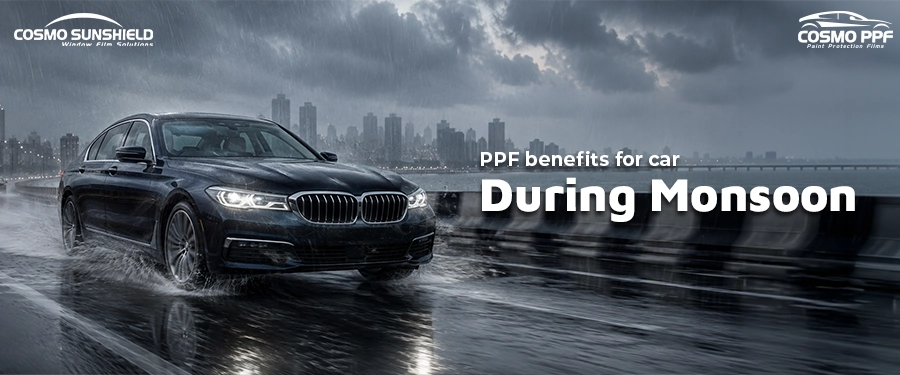
Every Indian monsoon runs the same experiment on every car parked outside. Acidic rain, mineral-heavy tap water, mud thrown up by hundreds of passing tyres, and a punishing sun the moment the clouds break.
Most monsoon car care advice still begins and ends with "wash it often." That covers maybe a third of what actually happens to paint between June and September. The rest is chemistry and physics that a chamois cloth cannot undo once it has set in. A physical barrier over the factory paint changes that equation, and that is what paint protection film is built to do.
Paint Protection Film creates a physical, sacrificial layer over a car's factory paint that blocks acid rain residue, mud, road grime, stone chips and bird droppings from reaching the clear coat. A hydrophobic top layer makes water bead off instead of drying into spots, and a self-healing topcoat can shrug off the light swirl marks that come from washing a car every other day for months on end. PPF does not stop rust that has already started, does not prevent flood damage, and does not replace washing. It reduces how much damage reaches the paint in the first place.
Table of Contents
- Why Indian Monsoon Roads Are Harder on Paint Than Rain Alone
- What Actually Damages Car Paint During Monsoon
- How PPF Responds to Every Monsoon Threat
- Paint Isn't the Only Thing Monsoon Attacks
- Which Panels Need Protection First
- Maintaining PPF Through the Monsoon
- Is It Worth Installing PPF Before Monsoon
- FAQs
Why Indian Monsoon Roads Are Harder on Paint Than Rain Alone

Rain is not really the problem. What Indian traffic and Indian roads do to that rain is the problem.
Dense traffic means a car sits in contaminated spray for longer than it would on an empty road, since every passing vehicle adds its own wave of mud and oily runoff. Construction dust, common on the approach roads to almost every Indian city, turns the first hour of rain into an abrasive slurry rather than clean water. Drainage that cannot keep up with the rainfall means many commutes involve standing water mixed with brake dust and engine oil, not puddles of rain alone.
The threat also changes shape depending on where the car lives.
|
City or Region
|
What Monsoon Adds to the Threat
|
Extra Risk to Paint
|
|
Delhi-NCR
|
High particulate pollution mixes
into rainfall, making runoff more acidic. Dust storms often follow heavy
showers.
|
Acid etching, swirl marks from
post-rain dust
|
|
Mumbai
|
Waterlogged streets keep lower body
panels submerged in contaminated water for hours during a single commute.
|
Rocker panel staining, prolonged
moisture exposure
|
|
Bengaluru
|
Broken and under-construction roads
turn red laterite mud into an abrasive paste that clings to lower panels.
|
Fine scratching during washing,
stubborn mud staining
|
|
Chennai and coastal cities
|
Salt-laden coastal air combines with
the northeast monsoon's sharper, later downpours.
|
Corrosion risk at existing chips,
humidity-driven dullness
|
|
Pune and hill-adjacent routes
|
Sudden downpours on ghats and hilly
approach roads fling loose gravel at higher speed.
|
Concentrated stone chips on bonnets
and bumpers
|
A car driven only in one of these environments faces a narrower version of the problem. A car driven across two or three of them, which describes most highway trips out of any major Indian city, faces all of it at once.
What Actually Damages Car Paint During Monsoon
- Acid rain and pollution residue
Rainwater over Indian cities picks up sulphur and nitrogen compounds from vehicle and industrial emissions on its way down. Once the water evaporates, the residue stays behind and can etch the clear coat if it sits for days.
- Water spots and hard water
Both rain and tap water carry dissolved minerals. As the water dries, the minerals stay on the surface and can bond to the clear coat over repeated wet and dry cycles.
Monsoon mud is rarely just soil. It carries sand, brake dust and small stones. The real damage usually happens during washing, when this grit gets rubbed into the paint instead of rinsed off first.
- Stone chips and flying debris
Wet roads loosen gravel and broken tarmac. Tyres from passing traffic fling this debris at speed, chipping paint on bonnets, bumpers and mirrors.
- Bird droppings and tree sap
Both stay wet for longer in humid monsoon conditions, giving their acidic compounds more time to react with the clear coat before anyone notices.
Wiping a muddy car with a dry cloth, or skipping the rinse before shampooing, is one of the most common causes of the fine swirl marks owners blame on "the rain" months later.
How PPF Responds to Every Monsoon Threat
|
Monsoon Threat
|
What Happens Without Protection
|
How PPF Helps
|
|
Acid rain residue
|
Slowly etches into the clear coat,
leaving dull patches
|
Physical film layer keeps acidic
residue off the actual paint
|
|
Water spots
|
Mineral deposits bond to the paint
as water evaporates
|
Hydrophobic top coat makes water
bead and roll off before it dries
|
|
Mud and road grime
|
Grit gets rubbed into the clear coat
during washing
|
Contaminants sit on the film rather
than the paint, and rinse off with less scrubbing
|
|
Stone chips
|
Chips expose bare paint and can
invite corrosion
|
TPU film absorbs the impact instead
of the paint underneath
|
|
Bird droppings and tree sap
|
Acidic compounds etch paint if left
for hours
|
Stains sit on a replaceable film
layer, not the irreplaceable factory paint
|
|
Washing-induced swirl marks
|
Fine scratches accumulate from
wiping and rubbing
|
Self-healing top coat recovers from
light marks with heat or sunlight
|
The pattern across every row is the same. PPF does not make contaminants disappear. It gives them something to damage that is not the car's actual paint.
Why TPU PPF Matters During Monsoon
For car owners looking for PPF for monsoon, the film material matters as much as the coverage.
Premium TPU PPF, such as Cosmo PPF, is designed to provide a durable protective layer against everyday road contaminants, stone chips and minor surface damage.
When comparing the best PPF for a car, look beyond price and consider the film's material, thickness, self-healing properties, hydrophobic top coat, optical clarity, warranty and installation quality.
Which Panels Need Protection First
|
Panel
|
Why It Matters in Monsoon
|
|
Bonnet and front bumper
|
First point of contact for spray,
stone chips and insect residue
|
|
Fenders and side mirrors
|
Take direct tyre spray from passing
traffic
|
|
Door edges and handle cups
|
Repeated touch points that pick up
grit on entry and exit
|
|
Rocker panels and lower doors
|
Sit closest to standing water and
mud splash
|
|
Wheel arches
|
Prolonged exposure to wet grit
thrown up by the tyres
|
A partial kit covering these five areas handles most of what a monsoon commute throws at a car. Full-body coverage adds protection on the roof, pillars and remaining panels for owners who want the whole car shielded, not just the parts that take the worst of it.
What PPF Does Not Protect Against
Being upfront about the limits matters more than the sales pitch. PPF does not protect against:
- Rust that has already started on exposed metal before installation
- Flood or waterlogging damage to the engine, electricals or interior
- Paint scratches or chips that existed before the film went on
- Damage from major impacts, dents or collisions
A car with existing rust or deep scratches needs paint correction before PPF goes on, not instead of it. PPF protects the paint that is there. It cannot repair the paint that already failed.
Maintaining PPF Through the Monsoon
Good PPF maintenance in monsoon does not require complicated routines.
- Rinse mud off before it dries, rather than wiping it away dry
- Use a pH-neutral car shampoo, not a household detergent or degreaser
- Dry with a clean microfibre towel instead of letting water evaporate on its own
- Clean off bird droppings and tree sap the same day they land
- Check film edges every few weeks for any lifting, especially around door handles and bumper corners
- Avoid directing a high-pressure washer jet straight at film edges
None of this is more demanding than caring for unprotected paint. It is easier, since dirt has less to bond to. It is just not zero effort.
Is It Worth Installing PPF Before Monsoon
For a car driven daily, parked outdoors, or taken on routes that cross flood-prone or construction-heavy stretches, the answer is usually yes. Dark-coloured and premium vehicles show swirl marks and water spots more visibly, which makes the case stronger still.
Timing matters. Installing PPF just before the season starts, with a few dry days for the film to cure, gives it the best chance to perform once the rain arrives. Film applied and immediately exposed to heavy rain before curing is more likely to show edge lifting later.
For a car already showing chips, water etching or dulled paint, correction should come first. PPF locks in the condition of the paint underneath it. It does not reverse damage that already happened.
Paint Protection Film Benefits in Monsoon
1. Is PPF actually useful during the Indian monsoon?
Yes. It creates a physical barrier between the car's factory paint and the acid rain residue, mud, road grime and stone chips that Indian monsoon driving produces daily.
2. Does PPF stop water spots completely?
Not completely. A hydrophobic top coat makes water bead and roll off faster, which reduces how often spots form and makes the ones that do form easier to wipe away.
3. Can PPF protect against acid rain?
Yes, as a barrier. The film takes the acidic residue instead of the paint underneath. Prompt washing after heavy rain still helps, since residue left on any surface for days is harder to remove.
4. Does PPF prevent rust?
No. PPF protects painted surfaces from contaminants and minor impacts. It does not treat the underbody, chassis or any area where metal is already exposed. Rust prevention still needs underbody coating and regular inspection.
5. What makes PPF hydrophobic?
The top coat is engineered so water forms beads instead of spreading into a sheet. Beaded water rolls off the surface faster, taking dirt with it and leaving less time for mineral deposits to dry and bond.
6. How does the self-healing top coat work?
The top layer has shape memory. Light scratches or swirl marks realign under heat, whether from direct sunlight or warm water, and the surface returns close to its original smooth finish.
7. Is ceramic coating enough on its own for Indian monsoons?
Ceramic coating handles gloss, water repellency and easier cleaning well, but it does not absorb physical impact the way a film does. Stone chips and gravel hits are better handled by PPF.
8. Which parts of the car need PPF most during monsoon?
The bonnet, front bumper, fenders, side mirrors, door edges and rocker panels take the most direct exposure to spray, grit and debris.
9. How much does PPF cost for a car?
In India, PPF costs roughly ₹15,000–₹30,000 for partial coverage and ₹60,000–₹3,00,000+ for full-body coverage depending on car size and film quality. Premium options like Cosmo PPF offer long-term value by reducing paint repair costs over the years.
10. How often should a PPF-protected car be washed in the rains?
Roughly once a week, or sooner after driving through heavy rain or waterlogged streets. Letting contaminants sit on the film for extended periods still causes staining over time.
11. Does PPF need time to cure before it can handle rain?
Yes. Exposing freshly installed film to rain before it cures can affect adhesion and long-term durability. Installers will usually specify a curing window.
12. Will PPF protect my car if it's driven through waterlogged streets?
It protects the painted panels above the waterline from staining and abrasion. It does not protect the engine, electricals or interior from flood or waterlogging damage.
13. Is partial PPF enough, or do I need full-body coverage?
Partial coverage on the high-impact panels handles most monsoon damage. Full-body coverage adds protection on the remaining panels for owners who want the entire car shielded.
14. Does PPF affect a car's resale value?
Preserving the original factory paint generally supports resale value, since it reduces the need for repainting or paint correction before a sale.
15. Is professional installation necessary for PPF to work properly?
Yes. Proper surface preparation, correct panel wrapping and clean edge finishing all affect how well the film performs and how long it lasts. Poor installation is a common cause of early edge lifting.
16. How long does Cosmo PPF last in Indian monsoon conditions?
Cosmo PPF Platinum is a premium PPF with 210 micron and it carries a lifetime warranty, backed by regular washing.