Paint Protection Film
Best Paint Protection Film (PPF) for Mahindra Thar ROXX
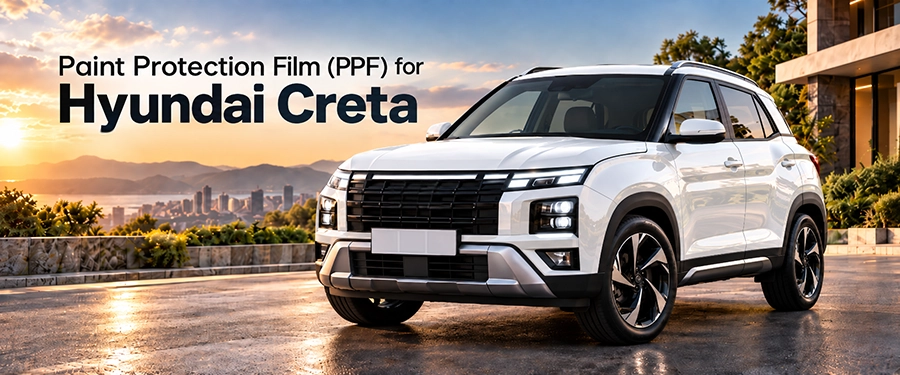
The Hyundai Creta does not need an introduction on Indian roads. Hyundai's own numbers put it as the country's top-selling passenger vehicle in June 2025 and the best selling SUV for the first half of that year, a run that stretches back to 2015 with over 1.2 million customers along the way. Ten years in and the car is still growing. Hyundai rolled out a new Lounge Edition on the King trim this month, adding a rear entertainment screen and cosmetic updates to a car that already sells itself.
That kind of popularity cuts both ways
for the paint. A Creta owner is sharing apartment basements, tight lane splits
and long expressway stretches with more Creta, more autos and more trucks
throwing up stone chips than owners of a rarer SUV ever will. Being everywhere
is good for resale demand. It is not good for a bonnet.
This guide walks through where a
Creta paint actually takes damage, what Cosmo PPF Platinum does about it, and
how to decide how much of the car to cover.
The Creta popularity works
against its paint, not for it. Higher sales volume means more Creta sharing
India's tightest parking lots and most pothole-scarred highways, and its raised
SUV stance puts the bonnet and front bumper directly in the path of stone chips
that a lower sedan would clear entirely.
Hyundai builds the current Creta on a
4,330 mm long, 1,790 mm wide body with genuine SUV proportions, not a hatchback
on stilts. That height is part of the appeal. Drivers get a commanding view of
the road, and the segment's own reviewers consistently rate the Creta ahead of
the Kia Seltos, Toyota Urban Cruiser Hyryder and Maruti Grand Vitara on cabin
comfort and feature count. The same stance means the front bumper and lower
bonnet sit exactly where a truck's rear tyres fling gravel on the expressway,
and where a scooter's footpeg catches a door panel in a crowded lane.
Add the ownership pattern that comes
with a car this common. Many Creta buyers keep the car for the long haul,
financing it over 5 years and planning to sell it into a used market where alone lists 250-plus used Creta in Delhi at any given time. A used
Creta with a chipped bonnet and swirl-marked black trim competes against dozens
of cleaner examples in that same listing page. Paint condition is one of the
few things a buyer can control before that day comes.
Stone chips hit the bonnet, front
bumper and fenders first because the Creta tall SUV nose meets debris kicked
up by trucks and buses at bumper height. Door edges and mirrors take the next
hit during parking, and the glossy black trim on Knight and King Knight
variants shows swirl marks faster than the car's regular painted panels.

Cosmo PPF Platinum is a 210-micron
thermoplastic polyurethane film with a self-healing top coat and a lifetime
warranty, built to sit over the Creta factory paint as a sacrificial layer
that absorbs stone chips before they reach the clear coat.
The self-healing property matters more
on a car like the Creta because so much of the damage it faces is exactly the
kind PPF is designed to erase. Fine swirl marks and light scratches from an
automatic car wash or a scraping branch soften and disappear with warmth,
whether that is a sunny afternoon or a few minutes of engine heat. Stone chips
and door-edge dings get absorbed by the film's thickness instead of cutting
into the paint underneath. Because Cosmo PPF Platinum is optically clear, none of
this changes how the Creta looks on day one, whether the car is finished in
Atlas White, Abyss Black or the King Knight's blacked-out treatment.
The lifetime warranty also fits how
long people actually keep a Creta. This is not a car most owners flip in two
years. A film that is only guaranteed for a handful of years starts working
against the owner right around the time paint correction and touch-ups would
otherwise become necessary.
Not all paint protection
film is the same product at different prices. The material a film is built on,
how thick it is and how long it is warranted are the three things that decide
whether it is still doing its job in year five.
|
|
Entry-level /
standard PPF |
Cosmo PPF Platinum |
|
Base material |
Often TPH or PVC-based, or a thinner TPU |
Thermoplastic polyurethane (TPU) |
|
Thickness |
Commonly around 150 microns (6 mil) or less |
210 microns (8.5 mil) |
|
Self-healing |
Limited or absent on non-TPU constructions |
Heat-activated self-healing top coat |
|
Yellowing over time |
Lower-grade films can discolour under sustained UV within a few years |
Engineered against yellowing through the warranty period |
|
Warranty |
Typically one to five years |
Lifetime warranty |
|
Suits |
Short ownership, tight budgets, cars due for replacement soon |
Long-term ownership and resale-sensitive panels |
What this means in practice
on a Creta: a thinner film absorbs less of a stone chip's energy before the
impact reaches the clear coat, and a film that yellows changes the colour of
your bonnet against the rest of the car — a difference that shows up hardest on
light shades like Atlas White. Both problems tend to surface around years three
to five, which is exactly when a five-year film's warranty is winding down and
a Creta owner is still years away from selling.
The practical test when
comparing quotes: ask for the film's base material, its micron thickness and
its warranty term in writing. Those three numbers explain most of the price gap
between any two quotes on the same car.

Coverage should follow how the car is
actually used, not the lowest quote available. A Creta that spends its life in
city traffic has different exposure than one that runs highway kilometres every
week.
|
Coverage |
Panels covered |
Best for |
|
Front kit / partial |
Bonnet, front bumper, fenders, mirror
caps, headlamp surrounds |
City-only driving, tighter budgets,
first-time PPF buyers |
|
Full front |
Everything in the front kit plus full
bonnet and fender wrap, front door edges, door cups |
Frequent highway drivers, new-car buyers
wanting a visible film-line-free look up front |
|
Full body |
Every painted exterior panel, including
doors, rear quarters, rear bumper and boot lip |
King, King Knight and Lounge Edition
owners, long-term owners, anyone planning resale in 3+ years |
A few things to weigh before choosing:
Cosmo PPF Platinum pricing on a
mid-size SUV like the Creta runs from roughly the mid-teens in thousands of
rupees for a front kit up to the low lakhs for full-body coverage, moving with
the coverage chosen, the installer's labour rates and the condition of the
paint before installation.
To put that against the car itself: a
base Creta E petrol runs close to ₹12.4 lakh on-road in Delhi, and even the
fully loaded King Knight iVT or new Lounge Edition tops out past ₹23 lakh. A
full-body Platinum installation typically works out to somewhere between 4% and
15% of the car's on-road price depending on the variant and coverage level
chosen, a modest addition next to the car's own EMI when spread over a lifetime
warranty.
Three factors move the number more
than anything else:
The best time to install Cosmo PPF
Platinum is before the Creta factory paint picks up its first chip, which in
practice means booking the installation within the first few days of delivery.
A few specific windows are worth
planning around:
A professional Cosmo PPF Platinum
installation on a Creta runs through inspection, decontamination, precision
cutting and application, followed by a curing period before the car can be
washed.
The process itself involves checking
the car for existing chips or repainted panels, a full decontamination wash to
strip road grime and old wax, precision cutting of the film to match the
Creta specific panel curves, careful application with attention to the
bumper's contours and the fender's wheel-arch line, and a final inspection for
bubbles or lifting edges.
Once the film is on, plan around
Cosmo's stated timelines: allow 24 to 72 hours for the film to cure fully, and
hold off washing the car for 7 days after installation. After that, a
pH-neutral shampoo and microfibre towels keep both the film and the paint
underneath in good shape. Avoid pointing a pressure washer directly at film
edges, and wipe off bird droppings, tree sap and tar as soon as you notice them
rather than letting them sit through a few commutes.
PPF and ceramic coating solve
different problems, and a Creta benefits most from both rather than picking one
over the other.
|
|
Paint Protection Film |
Ceramic Coating |
|
What it does |
Physical barrier against stone chips,
scratches, door dings |
Chemical layer that adds gloss and repels
water, dirt |
|
Protects against |
Impact damage, deep scratches, swirl
marks |
UV fading, water spots, light
contamination |
|
Typical lifespan |
Years, up to lifetime with Cosmo PPF
Platinum |
Typically 1 to 3 years per application |
|
Where it goes |
Bonnet, bumper, fenders, doors (as
chosen) |
Full body, over or alongside PPF |
A Creta loaded with a panoramic
sunroof, Bose sound system and dual 10.25-inch screens spends a lot of cabin
time exposed to direct sun, which is where Cosmo Sunshield automotive window film earns
its place alongside PPF rather than after it.
Paint protection film guards the
outside of the car. It does nothing for the heat coming through the Creta large glass area or the UV exposure hitting the leatherette seats and
piano-black dashboard reviewers already flag as scratch-prone. A window film
pass cuts cabin heat load, protects the interior trim from sun fading, and adds
a layer of privacy and shatter resistance, rounding out the exterior PPF into a
full ownership package rather than a paint-only fix.
Paint protection film is not a repair
product, and setting that expectation early avoids disappointment later. It
creates a barrier against future damage rather than undoing damage that already
exists.
A car that sells this well attracts a
particular kind of wear, from tight apartment parking to long highway stretches
shared with more trucks and more Creta than any rarer SUV will ever see. Cosmo
PPF Platinum's 210-micron TPU film and lifetime warranty are built for exactly
that kind of ownership. Front-kit coverage handles the daily city commute on a
tighter budget, and full-body coverage makes the most sense for King, King
Knight and Lounge Edition owners protecting darker paint and glossy trim
through years of ownership. Either way, get the film on while the Creta factory paint is still clean, and pair it with a Cosmo Guard ceramic coating
and Cosmo Sunshield window film for protection that covers the whole car, not
just the panels PPF can reach.