Window Film
Cosmo Sunshield Window Films Guide: Types, VLT Law & Specs

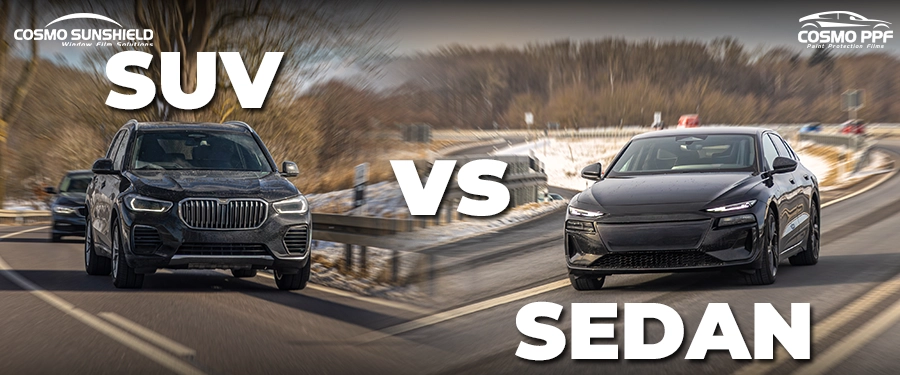
SUV sales in India have overtaken sedans for several years running and the gap keeps widening. According to most buyers “SUVs just look better". Its road presence and status are undeniable. Almost nobody mentions their actual commute or their road conditions.
That is the problem with how this decision usually gets made. It is treated as a trend to follow rather than a spec to match against a life. An SUV bought because it photographs well in the parking lot is a poor trade if it then burns 20% more fuel on a daily 15km city commute that never sees a bad road. A sedan bought purely to save money is just as poor a trade if it bottoms out every time the owner drives home to a town with no proper tarmac.
In this blog, we break down six factors that actually determine which body style suits you, namely ground clearance, road presence, cabin space, fuel economy, total cost of ownership, safety and city maneuverability.
SUV vs Sedan: Quick Comparison Table
|
Factor |
SUV |
Sedan |
|
Ground Clearance |
180mm to 220mm+ |
10mm to 175mm |
|
Road Presence |
High, commanding view |
Low, sporty stance |
|
Fuel Economy |
Lower (heavier, more drag) |
Higher (lighter, aerodynamic) |
|
Boot Space |
Often expandable with folding seats |
Fixed, separate compartment |
|
City Maneuverability |
Bulkier, harder to park |
Easier in tight spaces |
|
Starting Price (India) |
Generally higher for comparable specs |
Generally more affordable |
Ground Clearance and Road Conditions

This is where the SUV vs Sedan debate usually starts in India, and rightly so. Outside the top metros, road quality varies wildly. Potholes, unmarked speed breakers, flooded underpasses during monsoon, and unpaved stretches in smaller towns are still common.
SUVs typically offer 180mm to 220mm of ground clearance, giving them a real advantage on broken roads, rural routes, and during monsoon flooding. Sedans sit lower, usually 160mm to 175mm, which means more careful driving over speed breakers and a higher risk of scraping the underbody on bad stretches.
If you live in a city with well-maintained roads and rarely venture beyond it, this advantage matters less. If you travel between cities, visit hometowns with rougher infrastructure, or live somewhere that floods during monsoon, the SUV's clearance is a genuine practical benefit, not just a marketing point. Worth keeping in mind though, that extra rough-road exposure also means more loose chips and gravel hitting the front bumper and bonnet, which is exactly the kind of wear a layer of Cosmo PPF is built to absorb before it reaches the paint.
Space and Practicality for Indian Families

Indian car buying is rarely an individual decision. It usually factors in parents, kids, occasional guests, and a fair amount of luggage for weekend trips or annual hometown visits.
SUVs generally offer:
Sedans generally offer:
For a single working professional or a couple without kids, a sedan's boot and ride comfort are often more than enough. For a joint family or anyone who regularly drives 3 generations together, the SUV's space and easier ingress tend to win out.
Fuel Economy: Where Sedans Pull Ahead
Fuel costs add up fast in India, and this is the category where sedans consistently outperform SUVs.
Sedans are lighter and more aerodynamically efficient, which translates to better mileage, both in the city and on the highway. SUVs carry more weight and have a larger frontal area, both of which increase fuel consumption, particularly noticeable on petrol variants in city traffic.
The gap has narrowed with the rise of compact SUVs and strong-hybrid SUV options, but on a like-for-like comparison within the same segment and engine size, sedans still tend to deliver better fuel efficiency. If your daily driving is dominated by city commutes with heavy traffic, this difference compounds significantly over a year.
Price and Total Cost of Ownership
Sedans are generally priced lower than SUVs in the same segment, largely because SUVs require more steel, larger tyres, and often more powerful engines to move that extra weight.
Beyond the on-road price, consider:
Insurance: SUVs typically attract higher insurance premiums due to higher Insured Declared Value (IDV) and repair costs.
Tyres: SUV tyres are larger and cost more to replace than sedan tyres.
Maintenance: SUVs, especially 4x4 or AWD variants, often have higher service costs due to additional mechanical components.
Cess and Taxes: Depending on length, engine capacity, and ground clearance, larger SUVs can attract higher GST cess slabs compared to sedans, which directly affects the on-road price.
If budget is the primary constraint, a sedan typically gives you more features and a more powerful engine for the same money compared to an SUV in the same price bracket.
Safety and Highway Confidence
Both body styles can be equally safe today, since safety depends heavily on build quality, crash test ratings, and equipment rather than body style alone. That said, there are some real differences worth knowing.
SUVs sit higher, which gives drivers better forward visibility and a stronger sense of confidence in mixed traffic. However, that higher center of gravity also means SUVs are more prone to body roll during sharp cornering or emergency lane changes compared to sedans, which sit lower and generally handle more predictably at speed.
Always check Global NCAP or Bharat NCAP ratings for the specific model you are considering rather than assuming SUVs are automatically safer. A well-built sedan can outscore a poorly built SUV, and vice versa.
Resale Value: Which Holds Better in India?
SUVs have generally commanded stronger resale value in the Indian market over the past several years, driven by sustained consumer demand and the perception of higher ground clearance and road presence as desirable features in the used car market.
Sedans, while still holding decent resale value, particularly in segments with strong brand loyalty, have seen comparatively softer demand as more first-time and upgrade buyers shift toward SUVs.
This is not a universal rule. Specific models with strong brand reputation, reliability history, and low maintenance costs can hold value well regardless of body style. When in doubt, check resale listings for the exact model and variant you are considering rather than relying on body style alone.
City Driving and Parking

Sedans have a clear edge here. Their smaller turning radius, lower height, and more compact footprint make them noticeably easier to park in tight residential complexes, navigate narrow lanes, and squeeze into busy market parking.
SUVs, especially mid-size and full-size variants, need more room to maneuver and can feel cumbersome in dense urban environments, multi-level parking structures with height restrictions, and narrow old-city roads common in many Indian towns.
If most of your driving happens within city limits with frequent parking in tight spots, this is worth weighing seriously against the SUV's other advantages.
So, Which One Should You Buy?
There is no universal right answer, only the right answer for your situation. Use this quick framework:
Choose an SUV if:
Choose a sedan if:
5 Essential Car Accessories to Protect Your New Car for Years

Whether you drive home an SUV or a Sedan, the car represents a significant investment, and Indian conditions are not gentle on it. Dust, heat, monsoon humidity, stone chips on highways, and harsh UV exposure take a visible toll on paint, glass, and interiors within the first year if left unprotected. Here are the 5 accessories worth budgeting for at the time of delivery, in order of impact.
1. Paint Protection Film (PPF) for Scratch and Stone Chip Resistance
A transparent, self-healing layer applied directly over factory paint, Paint Protection Film is the single most effective way to keep a car's exterior looking new. It absorbs the impact of stone chips, road debris, and minor scratches before they ever reach the paint underneath, and it resists yellowing and UV-related fading over time. This matters more for SUVs that see frequent highway and rural driving, but it is just as valuable for sedans parked outdoors in sun-heavy cities. Cosmo PPF is built specifically for these conditions and is one of the easiest ways to protect resale value, since unmarked paint is one of the first things used-car buyers in India check.
2. Window Film for Heat and UV Protection
India's summer heat turns a parked car's cabin into an oven within minutes, and that heat speeds up dashboard cracking, seat fading, and AC strain. Cosmo Sunshield window film blocks up to 80% of in-cabin heat and filters out harmful UV rays that damage skin and upholstery alike over time. It also adds a layer of privacy and glass shatter resistance, useful in both SUVs with larger glass areas and sedans with lower, more exposed windshields. For a city like Delhi where summer temperatures regularly cross 40°C, this is a near-essential upgrade rather than a luxury one.
3. Seat Covers and Floor Mats for Interior Longevity
Interiors take a beating from daily use, spilled chai, muddy shoes during monsoon, and constant sun exposure through the windshield. Good-quality seat covers and all-weather floor mats are a low-cost way to protect upholstery and resale value without locking in a major spend. For families with kids or pets, this is often the highest-return, lowest-cost accessory on the list.
4. In-Car Technology Upgrades for Safety and Convenience
This is the category most buyers overlook at delivery and end up retrofitting later at a higher cost. A 360-degree reverse camera or parking sensor kit is genuinely useful in both body styles but becomes almost essential in larger SUVs where rear visibility is limited and parking in tight city spots is a daily exercise. A dashcam with front and rear recording adds a layer of protection that matters more than most buyers realise until they actually need the footage, whether for an insurance claim, an accident dispute, or simply keeping a record on long highway drives. Android Auto or Apple CarPlay integration through an aftermarket head unit is worth considering if your car's factory infotainment feels dated, since seamless navigation and call handling through your phone significantly reduces distraction. These are not luxury additions. In dense Indian traffic with unpredictable lane behaviour, they are practical safety tools.
5. GPS Tracker and Anti-Theft Device for Vehicle Security
Car theft in India, while not always headline news, is a real and consistent problem in dense urban areas. A concealed GPS tracker allows real-time location monitoring through a smartphone app and is invaluable in the event of theft or unauthorised use. Paired with a steering lock or an OBD port lock, it forms a layered security setup that significantly raises the effort required to steal or move the vehicle without the owner's knowledge. For SUVs parked overnight in open areas or sedans left in busy commercial zones, this is a low-cost accessory relative to the peace of mind it delivers.
SUV vs Sedan Frequently Asked Questions
1. Is an SUV and a sedan the same thing?
No. An SUV (Sports Utility Vehicle) is taller, has higher ground clearance, and typically more interior space. A sedan is a lower, three-box body style with a fixed separate boot.
2. Which gives better mileage, SUV or sedan?
Sedans generally deliver better fuel economy due to lower weight and better aerodynamics, though the gap has narrowed with newer compact SUVs and hybrid options.
3. Do SUVs really have better resale value than sedans in India?
In general, yes, SUVs have trended toward stronger resale value in recent years due to sustained demand, though this varies by specific model and brand reputation.
4. Is ground clearance really necessary if I mostly drive in the city?
Not significantly. If your driving is limited to well-maintained city roads, a sedan's lower ground clearance is unlikely to cause practical issues.
5. Which is better for highway driving, SUV or sedan?
Sedans generally offer a more planted, predictable feel at high speed due to a lower center of gravity, while SUVs offer a commanding view and more stability over rough highway patches.
6. Is Cosmo PPF worth it for a new car in India?
Yes, for most buyers. Cosmo PPF protects against stone chips, scratches, and UV-related paint fading from day one, which matters in Indian conditions. It is most valuable on high-impact panels like the bonnet, bumper, and fenders, and it directly supports resale value since unmarked paint is one of the first things used-car buyers check.
Looking to protect your new SUV or sedan? Explore Cosmo PPF, Cosmo Sunshield, and Cosmo Guard ceramic coating to keep your car looking new for years.