Paint Protection Film
Hyundai Creta Paint Protection Film Cost & Coverage: Is It Worth It?
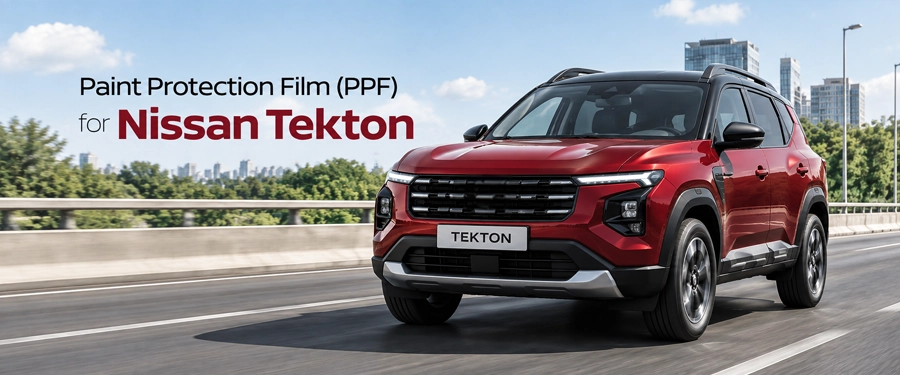
If you are reading this, there is a good chance your Nissan Tekton is either sitting in your driveway with the delivery plastic barely off, or it is a few weeks away from handover.
That timing is the whole point of this guide. Nissan launched the Tekton in India on 9 July 2026 at introductory ex-showroom prices from ₹10.49 lakh to ₹18.59 lakh, across twelve variants spanning the Visia, Visia+, Acenta, N-Connecta, Tekna and Tekna+ trims, and built at the Renault Nissan Automotive India plant in Chennai. Nissan's own positioning for the car is direct about where the design comes from: "the premium SUV inspired by the legendary Patrol." Every Tekton on an Indian road today is a matter of weeks old. Not one of them has had time to collect a season of stone chips, a basement-parking door scuff or a set of swirl marks from a rushed car wash.
Paint protection film is one of the few ownership decisions where being early is worth more than being thorough. A film applied over untouched factory paint preserves exactly what you took delivery of. The same film applied eight months later preserves eight months of accumulated damage underneath it, permanently, because the film is transparent.
This guide covers what to check before you sign the delivery paperwork, where a Tekton's paint takes damage first and why, how to choose coverage in your first fortnight, what it costs, and the aftercare habits that decide how the car looks in year five.
Table of Contents
Why the First 30 Days Decide How Your Tekton Ages

Your Tekton has perfect paint right now but you cannot retain it forever. Every drive adds something small: a stone chip on the bonnet, a scratch near the door handle, swirl marks from a quick wash. None of it looks serious on the day it happens. Put a year of it together and that is what makes a new car start to look used.
There is also a practical sequencing reason to move early. Paint protection film goes on best over a surface with nothing to correct. If you wait six months, a good installer will insist on paint correction first, because applying transparent film over swirl marks locks them in. Correction adds cost, adds a day to the job, and removes a thin layer of clear coat that you only get once. Booking in week one skips that entire step.
The last reason is what owners tend to discover the hard way. Damage does not arrive on a schedule. One gravel truck on one Tuesday puts three chips in a bonnet that was flawless on Monday. There is no warning, and there is no undo.
Day Zero: Your Delivery Inspection Checklist
Do this in daylight, before you sign, and before the car leaves the dealership. Transport and yard damage is the dealer's problem right up until you drive away, and yours immediately afterward.
Anything you find here should be resolved with the dealer before the film goes anywhere near the car. Film is transparent, and it preserves what is underneath it.
What Cosmo PPF Platinum Actually Does
Cosmo PPF Platinum is a 210-micron thermoplastic polyurethane film with a self-healing top coat and a lifetime warranty. It sits over your Tekton's factory paint as a sacrificial layer, taking the impact that would otherwise reach the clear coat.
Three properties matter for the damage map above.
At 210 microns, the film has enough depth to absorb the energy of a stone chip before it reaches paint. This is what protects the bonnet, the leading edge of the doors and the sills on rough-road drives.
Fine swirl marks and light scratches — the wash marks, the branch that caught a door, the fine sandblasting behind the front wheels — soften and disappear with warmth, whether that is a sunny afternoon or a few minutes of engine heat. This is the property that matters most on Onyx Black and Indigo Blue cars.
The film does not alter the colour of Flare Garnet Red, dull a Pearl White finish or change the look of a black contrast roof rather it makes your car more glossy. Installed properly, the only evidence of it is the absence of damage.
The lifetime warranty matters because of how long people keep a car like this. A film warranted for three or five years stops covering you at roughly the point where the alternative paint correction and touch-up would have become necessary anyway.
Choosing Coverage: Front Kit, Full Front or Full Body

Coverage should follow how you actually drive, not the cheapest quote on the table.
Front kit costs the least, full body the most, full front sits between them.
A car booked in the delivery week needs no correction. A car booked at month
eight usually does, and correction is billed on top.
The Tekton's sculpted bonnet, recessed bumper air scoops and pentagonal wheel
arch surrounds take more film and more installer time than flat panels would.
Dual-tone cars add the roof.
These are indicative 2026
figures for guidance, not fixed quotations. Your final number depends on your
variant, colour, coverage and city.
What to Ask Before You
Accept Any PPF Quote
Paint protection film is not
one product sold at different prices. Two quotes on the same Tekton can differ
by a lakh because they are quoting fundamentally different materials. Three
questions separate them.
Get all three answers in
writing before you commit. They account for most of the gap between any two
quotes on the same car.
Your First 30 Days: A Week-by-Week Plan
Week 1 — Inspect and book
Complete the
delivery checklist above. Raise anything you find with the dealer. Get quotes,
ask the three questions in the section above, and book your installation slot.
Keep the car out of automatic brush washes entirely, from day one.
Week 2 — Install
A
professional installation runs through inspection, a full decontamination wash
to strip transport film residue and road grime, precision cutting to the
Tekton's panel curves, careful application around the bumper scoops and wheel
arch surrounds, and a final inspection for lifting edges or bubbles. Expect the
car to be with the installer for a day or more depending on coverage.
Weeks 2 to 3 — Cure and
wait
Allow 24 to 72 hours for the film to cure fully,
and do not wash the car for seven days after installation. Light rain is fine.
Pressure washing, brush washes and polishing are not.
Week 4 — Settle into the
routine.
First proper wash: pH-neutral shampoo, two buckets, clean microfibre towels.
This is the wash routine for the rest of the car's life, so it is worth getting
right the first time.
Aftercare Habits That
Matter From Month Two Onward
•
Use pH-neutral shampoo and microfibre only
Brush washes are what put swirl marks into paint
and film alike.
•
Keep the pressure washer off the film edges
Hold the lance at an angle and keep your distance
from panel edges, where lifting starts.
•
Deal with bird droppings, tree sap and tar
the same day
These are acidic and they etch. Film buys you time,
not immunity.
•
Park in shade where you can
Particularly if your Tekton has the black contrast roof.
•
Let heat do the self-healing work
Light swirl marks lift on their own in sunlight.
There is no need to polish them, and polishing film is how people damage it.
The Panoramic Sunroof Problem Nobody Warns You About

The Tekton's panoramic
sunroof is one of its genuine pleasures. Autocar India's review notes that it
"adds a real sense of occasion, especially on scenic drives through the
mountains." The same review is blunt about the trade-off, observing that
"even at the lowest temperature setting, the cabin takes time to cool
down."
That combination is worth
understanding honestly. A large glass roof is a large solar collector. Every
square inch of it admits heat into the cabin, and the air-conditioning system
then has to remove that heat before you feel comfortable. Window film does not
repair or upgrade an air-conditioning system, and nobody should sell it to you
as though it does. What it does is reduce the heat load reaching the cabin in
the first place, so the system has less work to do and the cabin reaches a
comfortable temperature sooner.
Cosmo Sunshield automotive
window film addresses the part of the problem that is addressable: solar heat
rejection through the glass, UV protection for the padded leatherette dashboard
and door trims that reviewers rate highly on this car, plus added privacy and
shatter resistance. Paint protection film handles the outside of the Tekton.
Window film handles what comes through the glass. Neither substitutes for the
other, and on a car with this much glass, most owners end up wanting both.
Final Thoughts
The Tekton has been on
Indian roads since July 2026, which means the entire owner base is sharing the
same rare advantage at the same time: paint with nothing wrong with it yet.
That advantage has an expiry date and no warning attached.
A 212mm ground clearance is
what makes this car comfortable on surfaces that would unsettle something
lower, and it is also why grit reaches the doors and sills that a partial kit
skips. Full front is the right default for most owners. Full body is the right
answer for Onyx Black, Indigo Blue and Flare Garnet Red cars, for dual-tone
examples with the Onyx Black roof, and for anyone who intends to keep the car
well past its third year.
Get the film on while the
paint is still exactly as it left Chennai, and pair it with Cosmo Sunshield
window film for the sunroof and glass, and a Cosmo Guard ceramic coating once
the film has cured. That covers the whole car, not just the panels film can
reach.
Nissan Tekton Paint Protection Film (PPF) FAQ
1. Is PPF worth it on a Nissan Tekton?
Yes. The factory clear coat is only around 40–50
microns thick, making it vulnerable to stone chips, scratches and wash swirls.
Cosmo PPF Platinum, with its 210-micron protective layer, helps shield the
original paint from everyday damage. Its self-healing, scratch-resistant,
chemical-resistant and hydrophobic properties also help maintain the car’s
glossy finish.
2. How much does PPF cost for a
Nissan Tekton?
Cosmo PPF
Platinum costs ₹15,000 to ₹1.6 lakh depending on coverage: ₹15,000–₹30,000 for
a front kit, ₹35,000–₹60,000 for full front, and ₹1.1–₹1.6 lakh for full body.
Coverage is the biggest variable and paint condition the second, because a car
booked in delivery week needs no paint correction, which is billed separately
whenever it is required.
3. How soon after delivery should I
fit PPF on a new Tekton?
Within the
first two weeks. Finish your handover inspection and raise anything you find
with the dealer, then book the film before the daily commute starts adding
marks of its own. Film is optically clear, so it preserves whatever sits
underneath it. Fitted at week two it protects untouched factory paint. Fitted
at month eight it protects eight months of chips and swirl marks, permanently.
4. Which PPF is best for a Nissan
Tekton, and what is Cosmo PPF Platinum made of?
Judge any
film on three specifications: base material, thickness and warranty term. Cosmo
PPF Platinum is built on Lubrizol thermoplastic polyurethane with an Ashland
pressure-sensitive adhesive and a self-healing top coat, at 210 microns (8.5
mil), carrying a lifetime warranty. Entry-level films are commonly TPH or PVC,
around 150 microns, warranted for one to five years. TPU is the material that
delivers self-healing and yellowing resistance; the other two constructions
deliver neither reliably.
5. What is the difference between
Cosmo PPF Platinum, Gold+, Gold and Silver?
Cosmo PPF is
sold in four tiers, sharing the same self-healing, hydrophobic and UV-resistant
construction and differing in thickness and warranty term. Platinum is the top
tier at 210 microns with a lifetime warranty, and is the tier recommended for a
new Tekton intended for long ownership.
6. How many days will my Tekton be
with the installer?
Plan on a
day for a front kit and two to four days for full body, depending on how much
paint correction the car needs first. A Tekton filmed in delivery week skips
correction entirely, which is the shortest version of the job. Add 24 to 72
hours of curing afterwards, and wait seven days before the first wash.
7. Will PPF turn yellow on my
Tekton?
Cosmo PPF
Platinum is engineered against yellowing for the life of its warranty.
Yellowing is a failure of cheap film chemistry rather than a property of PPF as
a category: PVC and TPH films degrade under sustained UV and discolour within a
few years. On a Pearl White or Blade Silver Tekton it shows earliest, because a
yellowed film over light paint reads as a permanently dirty panel.
8. Does self-healing PPF actually
work?
Yes, on
light damage. The top coat on Cosmo PPF Platinum is elastomeric, so scratches
that do not penetrate the film close up when the surface is warmed by sunlight,
engine heat or warm water. Swirl marks from a wash, a scuff from a branch and
fingernail marks around the door handle all sit inside that range. A cut deep
enough to reach paint will not self-heal, and neither will a tear.
9. Does PPF void the Nissan
Tekton's warranty?
No. Cosmo
PPF Platinum is applied over the factory paint and involves no change to any
mechanical, electrical or structural part of the car, so Nissan's warranty is
unaffected. Keep your installation invoice, since it records that the film was
professionally applied should a paint claim ever be raised.
10. Can PPF be removed later
without damaging the paint?
Yes, on
sound factory paint. Cosmo PPF Platinum is removed with controlled heat by a
trained installer and leaves the paint as it was the day the film went on. The
risk sits with panels repainted before filming, or paint that was already
failing, because film can lift a poorly bonded respray on removal. It is one
more argument for filming a new car rather than a repaired one.
11. Does PPF improve resale value
on a Tekton?
It protects
the first thing every used-car buyer inspects. Paint condition is judged in the
opening seconds of a viewing, ahead of service history or mileage, and a
chipped bonnet is among the most common reasons an otherwise sound car gets
negotiated down. A Tekton filmed in its first month presents in unmarked
original paint years later, which is not a claim a repainted panel can make.
12. Is PPF legal in India?
Yes. Paint
protection film is transparent, sits on painted bodywork rather than glass, and
does not obstruct the driver's view, so the restrictions that apply to tinted
window film do not apply to it. A matte or colour-change film is a different
case: anything that alters the car from its registered colour should be
endorsed with your RTO.